
It’s time to touch grass.
“Truthfully, what we saw was all of our metrics going down,” says Bryna Corcoran, HubSpot’s director of Global Brand and Social Media.
Not an easy confession for the woman who overhauled our social strategy so successfully it was literally nominated for awards.
But when she went looking for the cause, she found that it wasn’t something we were doing wrong. It wasn’t that we were falling. Everyone was. For the first time since social media was invented, benchmark average use has fallen. And by a whopping 10% over the last few years.
“People are like, ‘It’s too much. I need to go outside and touch some grass,’” Bryna laughs. “But they’re not leaving the platforms entirely. They’re just being intentional about what deserves their eyeballs.”
So the question became: How do you make content that deserves attention?
Shooting for the Moon
Bryna started by auditing the wider marketing landscape and saw major shifts in strategy across industries and platforms.
“Even Duolingo, the gold-standard unhinged entertainment brand, is changing up their playbook, because they’re not getting the traction they used to.”
That’s when she stumbled across a post about StoryArb’s moonshot matrix.
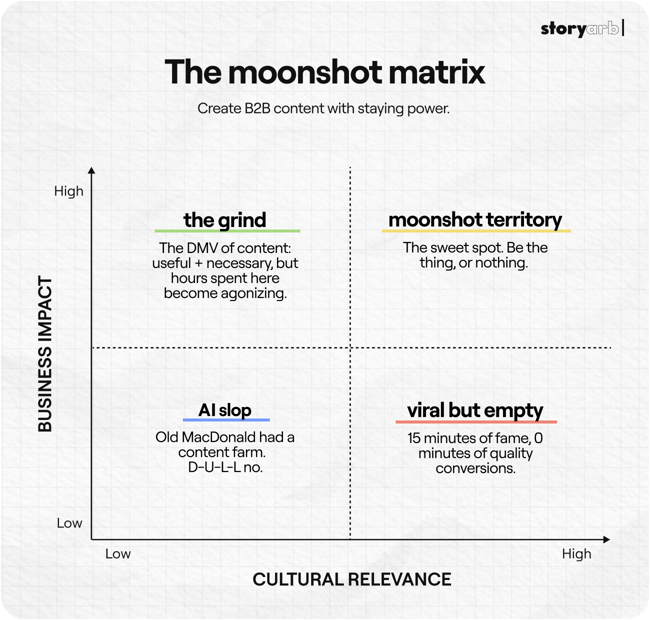
In a nutshell, the matrix puts your content on a map of cultural relevance versus business impact. To make memorable marketing, you need content that serves both your audience and your business goals.
StoryArb does a fantastic job of breaking down the philosophy you need to adopt, but below, Bryna spills the steps we took to actually put it into action.
Enter the Matrix
Now that we’ve got a moon to shoot for, let’s take a look at the high-level steps Bryna’s team took to get there.
1. Redefine the target audience.
The first truth bomb of the moonshot matrix is that virality without business impact is vanity.
The danger of chasing likes is that you’re probably targeting the folks most likely to click, not the folks most likely to buy.
“We’re trying to reach a decision maker, who is maybe director plus at a large company. Well, the behavior of that person is very different from someone who’s chronically online and junior in their career.”
And who are the likely decision makers? As of 2025, millennials have overtaken both Gen X and boomers in sheer number of management positions.
So the people signing contracts and awarding budgets are the people who know all the words to “Sk8ter Boi” by heart.
“They grew up on the internet, but they don’t have as much time for it now,” Bryna points out. “They want to be entertained, but they also want value. I’m in back-to-back meetings. I gotta get my kids to school. If I’m going to watch something, it better make me smarter.”
2. Redefine the goal.
Ideally, moonshot content will teach something actionable, wrapped in relatable humor or cultural relevance, and will solve a real problem while making the reader look smart when they share it.
Oh, is that all?
To actually do that, Bryna’s team tests every piece of content against three gates:
Laugh - “It’s the inside joke. It’s the relatable professional moment. It’s the casual, platform-native tone. We’re not a brand talking to them, we’re peers in the trenches.”
Learn - “This is us giving our trend research and our industry insights. It’s one thing to be entertained, but it’s another to think, ‘Oh! That’s something I can use!’”
Lead - “If we’re putting something out there, can she share it with her team to show she’s on top of it? Can she come away with something to screenshot and take to her boss to show she’s a leader, too?”
If it doesn’t tick off enough boxes, they don’t post it. “Every piece of content needs to deliver on at least two or three of these promises.”
3. Redefine success.
“For the last five to 10 years, most social teams have measured the basics. Impressions, likes, follower count. And when you total those up, you get an engagement rate.”
Bryna’s team is tossing those out the window.
“A like is a lazy way to engage. It’s like, BOOP!” She mimes a clicking gesture and then walking away. “We’re measuring things that show us that [our audience] actually got something from it. We’re not just asking, ‘Did they see it?’ We’re asking, ‘Did they use it?’”
To that end, her team now judges success based on saves, shares, comments, and watch time/completion.
“A save is a signal that I found this valuable enough that I’m going to come back to it. A share is a signal that I found this interesting enough to show it to someone who may not even know what HubSpot is.”
Because, at the end of the day, if more people are sharing your content, who cares if algorithmic impressions are falling?
“We’ve been moving towards this moonshot strategy since December. Although we’re producing less content, our signals have gone up. Roughly 21,000 people slapped a share on our content, which means they’re willing to put their name next to ours. These aren’t vanity metrics.”
Fly me to the moon.
Now let’s dig into the fine details that really make the difference. Bryna shares her top tips for avoiding cringe and nailing the moment.
Post Less.
“We’re taking an audience-first approach, which might mean fewer posts. They can get memes and jokes and trend-jacking from anywhere now. People want quality, intentional, well-crafted content.”
Don’t just feed the beast.
Posting less can feel scary.
“There’s this expectation to just post, just get stuff out, just distribute content. We have to post all the time to be relevant and feed the algorithms,” Bryna says. “If you’re not growing your quality signals, then what’s it all for? When we were just feeding the beast, the beast was like, ‘I’m done eating junk food.’”
Be a colleague, not a corporation.
“People don’t open Instagram and think, ‘Gee! I hope I learn about marketing automation today!’ They’re there to be entertained or to decompress.”
Which doesn’t mean they’re not open to learning. But think about how you might share something educational with a friend or co-worker. That’s how you show up for your audience, too.
Don’t be too vibes-y.
The flipside of that is that you are still representing a brand. It’s important not to turn yourself into the “How do you do, fellow kids?” meme.
“We sometimes fall into thinking that we need to be fun and entertaining, because that’s the internet. But we’re also a brand, and that’s hard to do well without it feeling like, ‘Why is this coming from HubSpot?’”If the social team can’t explain why the joke would come from HubSpot, they don’t post it.
Focus on what decision makers care about.
“Your most chronically online audience isn’t necessarily your most valuable one,” Bryna explains. Instead, tailor your content to what a decision maker is looking for. “What are some of the pressures she’s under? What are the specific things she’s neck-deep in right now? What memes or songs or seasonal moments are in her feed?”
It might lead to less surface engagement, but the deeper quality signals should improve.
Target trends early or don’t bother.
Cringe comes when too many brands jump on the bandwagon and the wheels fall off. I’m having flashbacks to 2013 and every other company doing the Harlem Shake.
“If I’m starting to see onesie, twosie, threesie in my feed, we decide if we’re going to attack it. If by day two or three we haven’t jumped on it, we’re not gonna do it. At that point, it veers into cringe territory. Brand, you’re late.”
Don’t be afraid of jumping in too early. It’s far more forgivable than jumping in too late.
“People appreciate a brand that can be first because it takes cleverness to find the brand’s way in. It’s like, ‘Ah, I see what you did there, HubSpot.’”
Follow Virgil’s 3% rule.
The late founder of Off-White, Virgil Abloh, famously said, “A creative only has to add a 3% tweak to a pre-existing concept in order to generate a cultural contribution deemed innovative. For instance, a DJ only needs to make small edits to innovate a song. Likewise, a designer would only need to add holes to an iconic handbag to leave his mark.”
Bryna says this is one of the strongest keys to avoiding cringe.
“Don’t change the meme so hard that it’s clear the brand doesn’t understand it. If you’re going to have to Frankenstein it so that it feels like it’s coming from you, forget it.”
Shop it around.
“We didn’t just do this in a vacuum. We stepped back and asked what’s working and what’s not working. Then went to see if there’s research or thought leadership about what we’re seeing.”
But even with clear proof, you still need to make your overall strategy a group effort.
“After all that research, I didn’t just say, ‘This is our new world order. This is what we’re doing.’ I shopped it around with our social team, our creative partners, our leadership team, and said, ‘Are there things I’m missing? Are there any flags before we go live?’”
While this may take extra time at the beginning, the investment is worth it.
“Everybody was able to have their fingerprints on it. And that makes people more invested, because they were brought in early enough to shape it.”
Use AI to pressure test, not to create.
“It would be very cringe to just take what AI produces and put it out. But we’ve built some really great Claude and ChatGPT projects to help us nail tone of voice.”
Bryna’s team loaded these projects with customer profiles and data on the most effective content. This allows them to bounce ideas off of it, to fine-tune word choices, or to apply the flavors of successful content to new campaigns.
“Humans will always take it over the finish line, but we’re getting cleaner and faster output as we go.”
Give it time.
Lastly — and perhaps most nerve-wrackingly — you’ve gotta give it enough time to see if it’s working.
“I don’t think you’ll know week over week, because you’re at the mercy of the algorithm, the time of day, the cultural moment. And you can’t determine that in 24 hours.”
Bryna recommends giving your new strategy a full quarter.
“It’s like going to the gym. You’re not going to see gains if you go for two weeks and say it’s not working. If you do it for a quarter, stay consistent, and measure what’s working, you’ll get incrementally better over time. You’ll see it.”