.webp?width=48&height=48&name=BrianneGarrett_Headshot%20(1).webp)
The sanctity of a brand style guide is often underappreciated. But without one, tumultuous things happen: Audience trust erodes over time. Identity and point of view are all over the place.
As somewhat of an old-school journalist (can I say that as a late millennial?), I know this intimately. Which is why one of my favorite MAtG conversations to date was with Clare O'Connor, Bumble's first-ever Editorial Director (a role that later grew into Global Director of Editorial Content).
Friday Feature

O’Connor built the company's entire editorial infrastructure from scratch, shepherding it through explosive growth including the company going public.
We’re now seeing droves of editorial roles popping up in non-traditional publishing and media spaces; O'Connor sees this as an overdue correction.
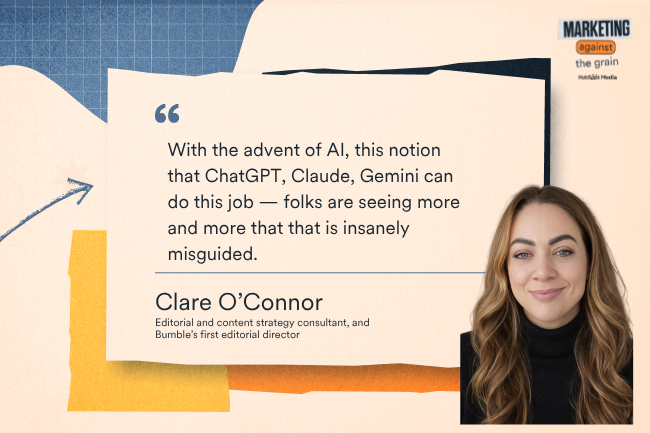
“This is not a nice-to-have,” she says. “Folks realize this is a strategy role good for more than just getting that blog post out. Especially now with the advent of AI, this notion that ChatGPT, Claude, Gemini can do this job — folks are seeing more and more that that is insanely misguided.”
Here's what she learned shaping editorial from scratch at a company that grew from 30 employees to 1,300 and eventually an IPO.
Build for pressure
When O'Connor joined Bumble in 2018, she was among the first 20 or 30 employees. The Austin office had just opened. There was no playbook for what an editorial director at a dating app was supposed to do.
Her starting point was simply, in true journalistic fashion, speaking to people. Specifically, the people closest to the user: customer support, trust and safety, user experience.
"There was nothing more useful to me than going to the source," says O'Connor. "These are folks who are in the line of fire every day. They know what is working and what is not working."
From there, the brief wrote itself. A style guide, in O'Connor's eyes, should operate more like an infrastructure. It’s not just words or arbitrary rules like whether or not to use the Oxford comma.
The real test is how it holds up under pressure: when there's a product launch, a legal concern, a crisis comm situation, a joke that needs to land without being flippant.
"That's the real work of an editorial director,” she says. “Making sure your language can apply when it's stress tested."
Key takeaway: The real measure of a style guide is how it holds up when things get hard.
Know which hills to die on
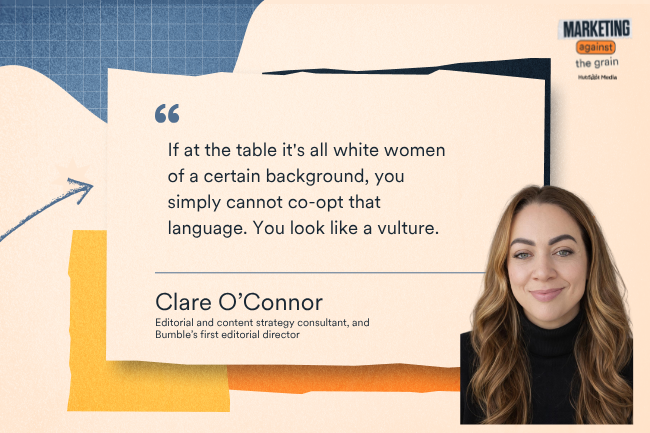
When Bumble was still a startup with a young, predominantly white team, O'Connor vehemently pushed back on the casual co-opting of AAVE and language rooted in Black and LGBTQ+ culture. "If at the table it's all white women of a certain background, you simply cannot co-opt that language," she says. "You look like a vulture."
 As Bumble grew into a household name, that same instinct got tested in higher-stakes settings. The company stood firm in making philanthropic donations to organizations doing important, often politicized work — but O'Connor wanted the brand to go further and always say plainly what it stood for. She hadn't fully accounted for what that would mean at scale, though. "I can wave a flag all I like for being plainspoken," she says. "But there's always something else at play."
Still, she's proud of what they were able to do, and the funding got where it needed to go.
Key takeaway: Hold your convictions. But let impact help determine which fights are worth having.
Judgment can never be automated
When audience surveys surfaced concerns about deep fake abuse material and whether matches were bots, O'Connor went to the source. This time, that meant the engineers.
The same instinct to have humans at the center of the work shaped one of Bumble's most successful editorial franchises: Success Stories. O'Connor made a deliberate choice to tell stories around the full spectrum of people using the app.
"Having folks from underrepresented communities covering other folks from those communities — that's one way to ensure you're being as sensitive as you possibly can," she says. She hired working journalists from the communities being covered, and paid them above industry standard to do it.
This is precisely the kind of work AI can't replicate.
"The floor has been raised by AI," she says. "But certainly not the ceiling. The danger isn't always that AI is making each piece of content worse. It's that it's making average or crappy content sort of infinite."
She believes style guides now need to anticipate how people inside a company will use AI, and build in the guardrails accordingly. "You need someone who understands content," she says, "who can stand up to AI."
A case well made for why a journalist should always be in the room.
Key takeaway: AI can produce content at scale, but it can't produce accountability. That will always require humans.



![The Tiny Layout Tweak That Led to 20% More Conversions [Test Results]](https://marketingagainstthegrain.com/hubfs/rebecca-hinton-matg-blog.webp)


![Stop wasting homepage traffic [3 big mistakes backed by 10+ years of data]](https://marketingagainstthegrain.com/hubfs/angela-gomez-matg-blog.webp)
