Where most B2B marketers are optimizing their Zoom setups, Raffi Salama is booking flights. “In-person is the ultimate cheat code right now on every single front,” he says.
Here’s how the CEO of Passionfruit, an AI orchestration layer for marketing departments.
Meet the Master

Raffi Salama
CEO, Passionfruit
-
Claim to fame: Raffi was on the founding team of Inter Miami, the Major League Soccer club co-owned by David Beckham. The business went from zero to $200M in about three years.
Lesson 1: Go where the blob isn't.
"One of the biggest maxims that we have internally at Passion Fruit is to operate outside the blob,” Salama says.
The blob isn’t the stuff of sci-fi nightmares, but it is still something to avoid, Salama explains. “Sometimes the blob is figurative — for example, you won't see us put out dry video content on LinkedIn.”
But sometimes the blob is shaped like a big city or big center of business. “I spend a lot of time in New York City,” says Salama, “but it also is just oversaturated and ultimately feels like the events and community landscape is just a wall of noise."
"There's a real misconception that businesses outside New York and SF aren't fantastic. Some of the most thoughtful, innovative marketers I've ever met are not on the coasts."
Grab your passport or RealID, it’s time to fly.
"If you go to Columbus, Ohio, there's a lot less community and events marketing. And I think just by being willing to hop on a plane, you put yourself in a bit more of a category of one, and you have some really deep conversations with marketers who are part of brilliant businesses."
Lesson 2: Give before you take.
The blob isn’t just about where you show up — it also guides how you show up when you get there.
Salama sees Passionfruit’s role as twofold: “Build an amazing product and create an inner sanctum of elite CMOs and senior marketers who want to pull the future forward. And our mandate is to bring that group together as much as possible.”
"What a lot of companies get wrong is that they take a lot before they give a lot.” Salama and Passionfruit have made it a point to do the exact opposite.
“The whole room is not going to be your ICP,” Salama says. But when you need to “create a vortex of excitement around what you’re doing,” anybody can spread the word. "You've got to be brave enough to create a bit of a magic melting pot.”
When you’re dreaming up your next event, think about a larger network than just potential customers. "You're trying to create disciples who see the world the way we see it and are happy to go out and tell other people about it."
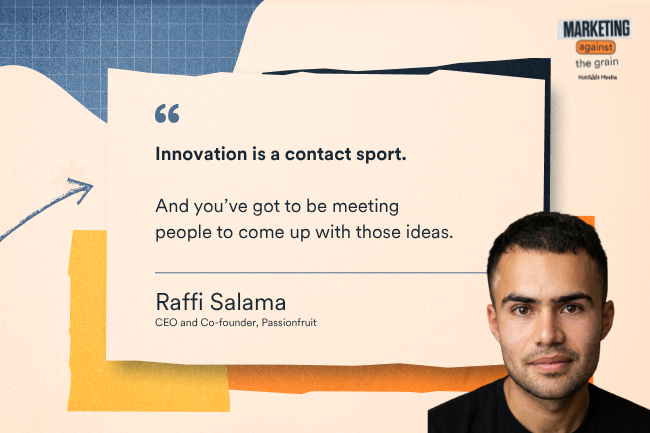
Salama says he’s a big believer that creativity doesn’t happen in a silo. “Innovation is a contact sport,” he says, “and you've got to be meeting people to come up with those ideas.”
Lesson 3: Let customers do the selling at your events — by design.
That magic melting pot isn’t Salama’s only sales play. Happy customers are, of course, also essential to spreading the word, especially with Passionfruit’s 40-day sales cycle.
Salama shares a typical timeline with me. "You meet us at one of our events, you hear about how another hospitality brand 3x'd their CRM attributed revenue using Passionfruit. By meeting one of our existing customers, it's like, ‘Huh, I need to have a conversation with these guys.' And then it goes from there."
Event curation is key — Salama builds the room around his existing customers, who might account for 50% of the invite list, with the other half representing a range of interests and personalities.
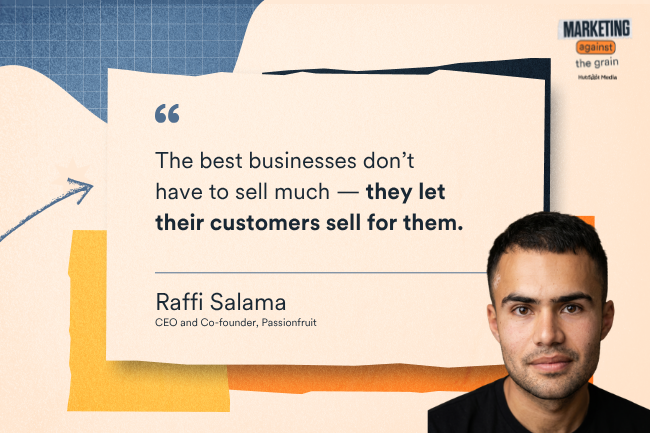
"The best events are where you have a bunch of customers already there. The best businesses don't have to sell much — they let their customers sell for them."
The question worth asking before your next event: Are you building a room to sell to, or building a room that sells for you?
Lingering Questions
THIS WEEK'S QUESTION
Where do you think AI helps marketers most today, and where does it still fall flat?
—Amanda Rothbard, Community lead, Gamma
THIS WEEK'S ANSWER
Salama says: Great AI-first marketing is about deploying a system of work that helps you understand what is going on, and then actually does the "doing" part to get you through your OODA loop faster... So that means you can win on areas like:
- Creative auditing/analytics. That mystery 50% is finally shrinking. You can personally (finally) see where money dies, ship-compliant/brand-safe work, and not be beholden to your agency telling you what's going on.
- Paid media. The biggest bucket marketers deploy, and the most unoptimized. Tighten the loop of decision --> outcome --> analysis --> new decision and performance just keeps climbing.
- Lifecycle content. There are two ways to grow: sell to new people, or sell more to people who already bought. The second is severely overlooked. Match what existing customers think with how you market to them, and you're going to see the $ grow. Most companies are sitting on a treasure trove of relationships doing nothing.
Not yet convinced generative creative is reliably good enough to win attention, but this will likely change by the end of 2026.
NEXT WEEK'S LINGERING QUESTION
Salama asks: What will always be true in marketing, despite all of AI's advances?