
Most of us are trying to sell software or services. Maybe sneakers or sofas.
Kevin Wong is trying to end suicide among LGBTQ+ youth. (But this newsletter is mostly about hope.)
Meet the Master

Kevin Wong
Chief communications officer, The Trevor Project
-
Claim to fame: Last year, The Trevor Project raised $20+ million in an emergency fundraiser — during a period of widespread donor fatigue, against a backdrop of federal funding cuts, and while dozens of other non-profits were also sounding alarms.
Lesson 1: Hope isn’t a soft add-on. It’s part of the strategy.
The first thing you see on thetrevorproject.org is a pop-up saying that you can quickly leave the site by pressing the ESC button three times. It’s a sign that the stakes here are real, and the people it serves are, too.
It’s the human part that Wong zeroes in on. “We work really hard on a pretty tough mission — ending suicide among LGBTQ+ young people. [It’s about] taking that and telling the human stories behind it.”
It can be dark at times, Wong admits. But even in times of despair, humans have the capacity — and need — for hope. The Trevor Project’s storytelling might include an LGBTQ+ young person who went through a tough time — but it also might look like “shining a spotlight on an adult who didn’t know about the identities or struggles of an LGBTQ+ young person in their life, [and who came] around to acceptance, educating themselves, and learning how to support that individual.”
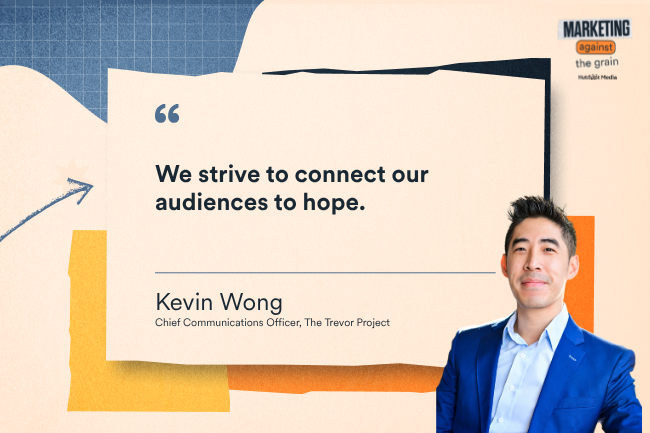
“We strive to connect our audiences to hope,” Wong tells me, pointing out that it’s even written into the organization’s branding. This is grounded in some practical considerations, like fending off compassion fatigue. But hope-as-strategy also quietly acknowledges the humanity of the people scrolling Instagram or navigating to The Trevor Project’s website.
To find your own version of this, Wong says to look for “whatever humanized storytelling is for you, your mission, or your company — and explore that.”
Lesson 2: Pair a problem with a path forward.
With hope as your backbone, you suddenly have a lot more options when bad news strikes.
And it struck The Trevor Project last year, to the tune of $25 million in eliminated federal funding. That’s not a one-time cut — it’s $25 million every year. The Trevor Project had a month to spin down a program it had spent years building up, and had to immediately cut down the number of LGBTQ+ youth it could serve.
What followed was the Emergency Lifeline, a two-part campaign to raise money and build awareness. And it worked: The Trevor Project raised $20 million.
Wong credits the approach. Yes, share the bad news, but don’t stop there. “We also give them a CTA. Here’s what you can do to channel your energy. Share this. Take this action. Sign up to advocate in your state. Redirect that energy, so it’s not always doom-and-gloom statistics.”
The impulse in a crisis is (for me, at least) to explain everything (How did we get here? What exactly is 988 funding and how is it structured? Why is my anxiety spinning out of control?). Wong and his team resisted that. Instead of providing a full accounting, they gave people something to do with the anger and grief they already felt.
Lesson 3: Shareability is a design decision, not an outcome.
The way the federal funding cuts were structured was a content marketer’s worst nightmare. Think grants, contractors, subcontractors, maybe even sub-subcontractors. It took a few minutes for Wong to explain it to me on a Zoom call, never mind trying to distill it into an Instagram story.
So for the campaign, he stuck with simplicity. “We landed on a message that said, ‘Hey, this is what's happening, this is the impact, and here's what you can do to help.’”
Wong says that The Trevor Project is incredibly lucky to have a deep bench of supporters around the world. But they’re still always trying to “pull people into the funnel so that they can see our social content.”
“It is very important for us to work with peer organizations and partner with celebrities and creators” — people whose followers may have heard of The Trevor Project but might not know about the sudden cut to funding.
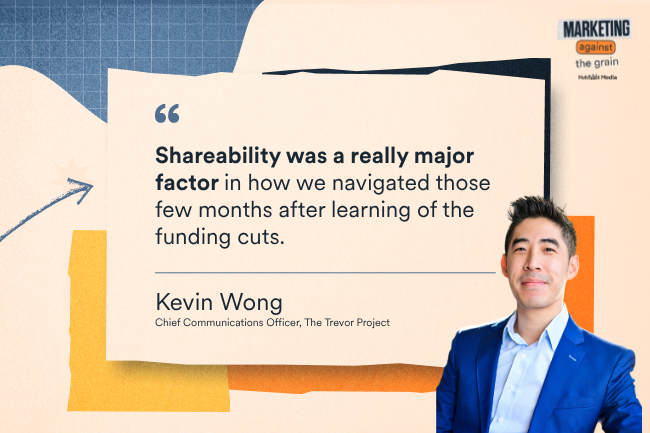
“Shareability was a really major factor in how we navigated those few months” after learning of the funding cuts. So next time you’re talking about raising awareness and building community, don’t just wait for followers to share your posts — design your campaign around it.
Lingering Questions
This Week's Question
When you're producing a campaign or building creative work with a partner, what's the North Star, the thing you protect no matter what? —Abrielle Kuo, Creative producer and partnerships strategist
This Week's Answer
Wong says: The Trevor Project's core demographic is LGBTQ+ young people, and their wellbeing serves as our North Star.
When our marketing, creative, and communications teams are building campaigns or working with partners, we always ask ourselves: Do the messages and creative help improve outcomes for LGBTQ+ youth? Will this campaign help us build a brighter future for LGBTQ+ young people? In addition to their experiences, do they see queer joy, possibility, and hope reflected in our work?
Our research, which surveys thousands of LGBTQ+ young people directly about their mental health experiences, tells us what our communities have known for a long time: visibility, support, and acceptance are critical to preventing suicide and fostering positive mental health outcomes.
Next Week's Lingering Question
Wong asks: How do you bring human-centered storytelling and narratives into your campaigns, and how are those stories expressed differently across platforms?

This week's email was brought to you by Laura M. Browning. Editing by Ben “Pairs every path forward with a problem” Berkley.
SUBSCRIBE TO OUR OTHER NEWSLETTERS
Business news, but not boring: The Hustle | Stay current on AI: Mindstream | Grow your business: Starter Story | Sell better: The Science of Scaling
Follow Marketing Against the Grain on LinkedIn and Instagram
Was this email forwarded to you? Sign up here.
Audience Intelligence


.png)
.png)
.png)