.webp?width=48&height=48&name=BrianneGarrett_Headshot%20(1).webp)
Karina Martinez doesn’t think that Latinas in sports are “underrepresented.” And she built an entire media company on the term she uses instead.
Meet the Master

Karina Martinez
CEO and co-founder of DRAFTED, the first Latina sports media company
- Fun fact: In a DRAFTED reader survey, more than 50% of respondents said that they used the World Cup to teach the next generation about their culture.
Lesson 1: Reframe “missing market” as “undervalued market.”
Martinez likes to use the term “undercelebrated” rather than “underrepresented,” a seemingly small shift that reframes DRAFTED’s entire place in the market.
The Latino consumer market in the U.S. is almost unfathomably large — Morningstar puts its economic strength at third in the world — and even narrowing that down to Latina women in sports results in a market that could hardly be described as “missing” or even “small.”
Martinez says that while “there’s some truth to” underrepresentation, “hidden within underrepresentation is undervalue.” When she was starting to build the DRAFTED community, “we learned pretty quickly that [Latinas in sports] are everywhere, from breaking records at college sports to sitting at the highest seats in sports management.”
“It's not about them not doing great things or being underrepresented. They're there.” And looking for undercelebrated stories is “our fun place to play.”
If your job is non-stop content production, it can be easy to burn out and wonder where your next story is coming from. The answer might not be easy, but for Martinez, it’s straightforward: “Celebrate the stories that have been historically undervalued … and bring a great narrative.”
Your move: Do a content audit. Who’s missing from the story — not because they don’t exist, but because nobody went looking for them?
Lesson 2: Let your audience nominate the story.
Martinez’s initial focus at DRAFTED wasn’t about the product at all. “Rather than focus on what product we were going to give our consumer, we spent probably the first year and a half building a community without selling them anything.”
She was able to “have a direct relationship with that consumer, and have a two-way conversation with her.” As a result, many of DRAFTED’s stories “come from within our audience — like nominating a person we wouldn’t know about.”
Whereas a national mainstream sports outlet might not have time to look at “the extra layers of a story,” those layers are DRAFTED’s bread and butter. “We don’t tell stories based on people who have a lot of clout or a big following,” she tells me. “Our job is to tell the story of the everyday girl.”
She attributes her close relationship with DRAFTED’s consumers as a way that helps her “maintain a really strong flywheel within our business.”
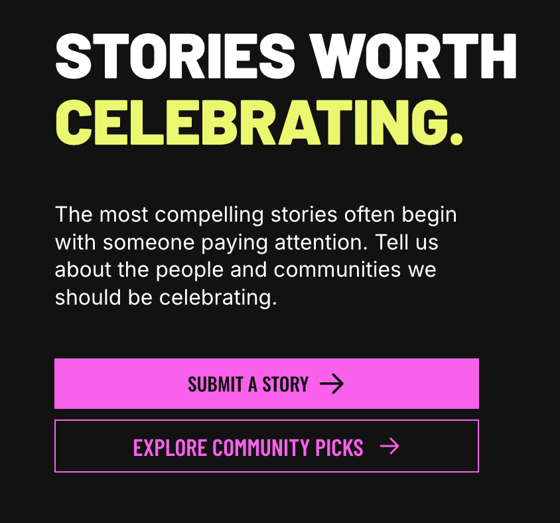
Story submission form on wearedrafted.co.
“Know your audience” isn’t anything new to content marketers. But taking the time to do so — without selling anything — is something Martinez sees as a core differentiator for DRAFTED. “It’s a very community-centered business model.”
Your move: Build a story pipeline, whether that’s by setting up a form, opening your DMs, or doing reader surveys.
Lesson 3: Be a mirror to culture, not its maker.
“A lot of brands like to say that they set culture, build culture,” says Martinez.
“And we are pretty adamantly against that belief, because I think it's the community that builds culture. It's our job as brands and media to be a mirror to that.”
That filters into DRAFTED’s most fundamental beliefs about storytelling. “It’s not about how we can change a trajectory or build a trend,” Martinez says, “but how do we really act as the responsible mirror of what’s already happening, and bring in those voices and those stories?”
In other words, she says, “it’s not about representation. It’s about contextualizing.”
In practice, that might look like “a mainstream topic that maybe on its face doesn’t seem to have a cultural narrative, but has a cultural impact.”
She cites an early article they did on U.S. former soccer player Megan Rapinoe. “Of course she’s not Latina, but the work that she’s done — the efforts, the advocacy — have built this new wave of women’s sports, particularly women’s soccer.”
And that does impact her audience. Rapinoe created “a giant ripple effect for young girls and Latinas, because soccer is a very accessible sport.”
“It is not so much about [finding a] brown person or a brown story. It's about what story exists and what layers we can use to give more context to this audience to make it relevant, to make them care.”
Your move: Create an editorial checklist (I’m a sucker for an editorial checklist). Lay out your criteria to answer the question, “Does this story have cultural relevance to my audience, even if it’s not ‘on-brand’?”

This week's email was brought to you by Laura M. Browning. Editing by Jana Rumberger.
SUBSCRIBE TO OUR OTHER NEWSLETTERS
Business news, but not boring: The Hustle | Stay current on AI: Mindstream | Grow your business: Starter Story | Sell better: The Science of Scaling
Follow Marketing Against the Grain on LinkedIn and Instagram
Was this email forwarded to you? Sign up here.
Community Levers


