B2B advertising has historically had a reputation problem. Fixing it has become a core pillar of Keith Browning’s job at LinkedIn.
“We’re helping to write that playbook,” says Browning. He’s intent on helping to re-shape how an entire industry thinks about brand, creativity, and what B2B advertising can actually look like. That means actually walking the walk: using LinkedIn as both the thought leader pushing B2B creativity forward and the proof of concept that it actually works.
Browning broke down exactly how he’s doing it, and why he thinks the industry is still just getting started.
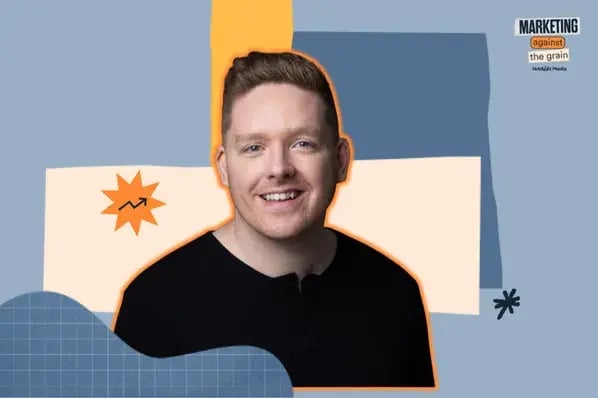
Keith Browning
Director of Global Brand Marketing at LinkedIn
Claim to fame: He helped build Cannes Lions’ B2B category — then LinkedIn took home its first-ever Lion in 2025.
Lesson 1: Research is the original creative brief.
Before LinkedIn could change how the industry thought about B2B creative, it had to prove there was a problem.
Browning describes the founding of LinkedIn’s B2B Institute as the starting point. The Institute essentially functioned as an internal think tank, tasked with redoing foundational marketing research — work originally done by Les Binet and Peter Field, two of the most cited figures in modern marketing effectiveness, best known for their landmark research on the long-term value of brand building.
The classic 60/40 brand-to-demand split had become common practice in B2C but no one had actually tested whether it applied to B2B buyers operating on nine-month buying cycles with multiple stakeholders.
“We said, let’s work together and redo this research with B2B in mind,” says Browning.
There was a two-fold mission here: To publish the research and use it internally to build the business case. “We suddenly had this treasure trove of incredible research to lean on,” adds Browning. That became the foundation for getting buy-in and, eventually, real media budget.
Lesson 2: Practice what you preach.
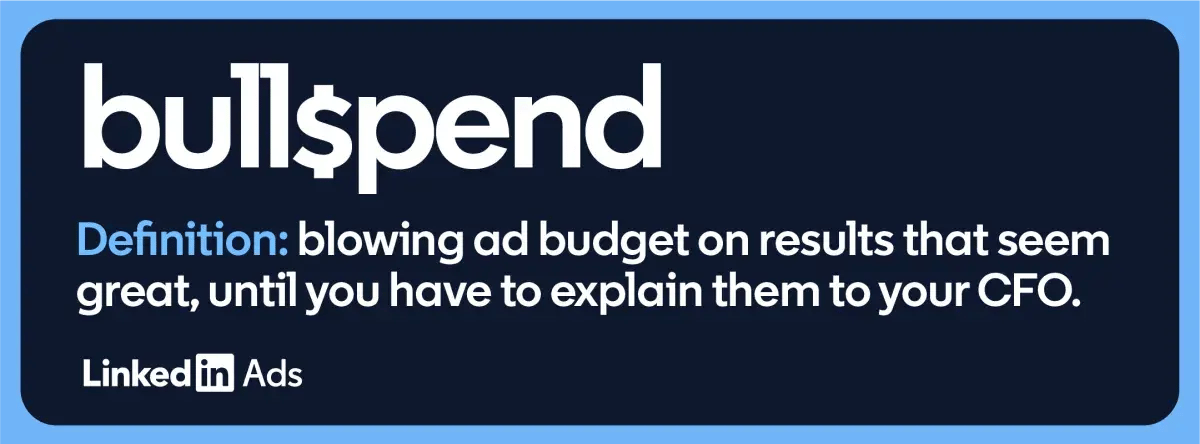
Browning and team ambitiously pursued collaborations with Maximum Effort (Ryan Reynolds’ production company) and documentary filmmaker Ben Proudfoot. More recently, they produced “Cut the Bullspend” — an ongoing campaign that calls out vanity metrics, essentially the guise of performance over actual business results.
Browning says the Maximum Effort work was a big launching point. “That was the first time we really pushed the creative envelope,” he says.
For the Proudfoot documentary, LinkedIn sent a crew to multiple continents to find and tell the stories of the world’s most creative B2B marketers, without a single mention of LinkedIn in the film itself. “It was very much an investment in the industry,” says Browning. It was also a direct extension of the Cannes Lions B2B category work. LinkedIn had helped introduce the category, but introducing it wasn’t enough.
“We can’t just introduce a category and then move on,” says Browning. “We have to make people aware that this category exists. We have to encourage entries.”
The documentary brought in more submissions, and further proof that the category was necessary, which in turn made the case for LinkedIn’s own products stronger.
“Cut the Bullspend,” meanwhile, represents the current chapter. It’s a long-term platform campaign that Browning is hopeful will run for several more quarters and is designed to do something B2B campaigns rarely attempt: Be genuinely memorable while still moving the needle, plus shift how B2B buyers perceive LinkedIn as an advertising platform.
Lesson 3: B2B needs its own winning plays.
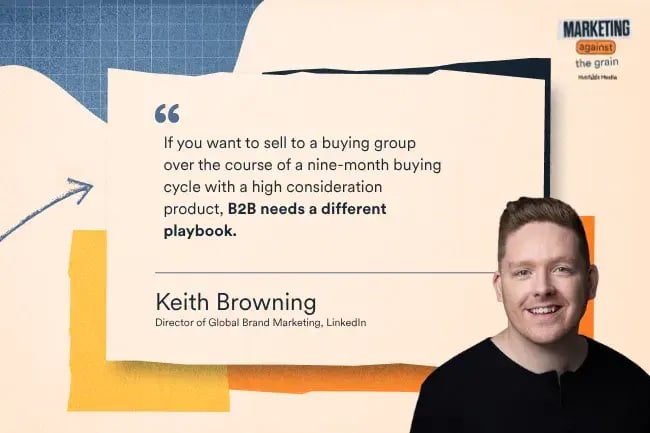
Most B2B marketing has been built on infrastructure designed for consumer brands, Browning notes. But, “If you want to sell to a buying group over the course of a nine-month buying cycle with a high consideration product, B2B needs a different playbook,” he says. “We’re helping to write that one.”
It’s a conviction that traces back to one of the most important lessons Browning says he’s ever received, from marketing expert Mark Ritson, whose foundational course reframed how Browning operates.
“He talks about marketing being a sequential process,” Browning explains. “There’s a step one, a step two, a step three. It doesn’t matter what brand you’re working on — there’s a way marketing should go.”
He believes that understanding how everything connects, and in what order, is what separates marketers who react from marketers who lead. Applied to B2B, it means resisting the urge to copy B2C playbooks and instead build from first principles.
That conviction shapes the products LinkedIn builds, all developed specifically for how B2B buyers actually behave, not how B2C consumers do.
Make no mistake: There’s still room to give what works well in B2C — like creator partnerships — a B2B reinvention. “The idea of creators in B2B is absolutely still in its early stages,” he notes. “But that’s what makes it exciting.”