.webp?width=48&height=48&name=BrianneGarrett_Headshot%20(1).webp)
When COVID hit, Joanna Ericta was furloughed from ZipRecruiter, navigating deep family health challenges while the career she’d built her identity around disappeared overnight.
What followed was a series of unlikely yeses and some hard nos — starting with managing a growing Facebook community for executive assistants at Snack Nation, a B2B snack delivery service with over 10,000 group members, co-founded by her then-boyfriend, now-husband. When members started asking for a streamlined digest of the best advice being shared in the group, Ericta saw the opening. So she launched The Assist.
By the time she went full time in April 2021, the newsletter had 10,000 subscribers. When ZipRecruiter came calling two weeks later, she turned them down.
“That’s when I fully said, ‘All right, I’m going to take this on,’” she says. “I am definitely an accidental entrepreneur.”
Today, The Assist sends four times a week to a highly engaged, mostly female professional audience of over 300k, with partners including Monday.com, Notion, and Apple, and a team of around 10.


Start where you are
When Ericta committed to The Assist, she knew almost nothing about the newsletter business. So she signed up for roughly 20 newsletters and reverse-engineered what she liked about each one. In the early stages, she started on MailChimp because it was the one email tool she already knew how to use. For content planning, the team used the free version of Trello. For the website, Wix.
“I was like, what tools do I actually know how to use? I’ll start there and figure it out along the way.”
The early growth strategy was similarly scrappy. The Assist was built on the back of the Snack Nation blog, which was pulling around a million visits a month.
Rather than starting from scratch, Ericta and her co-founders used that existing traffic to funnel subscribers for nearly three years — writing newsletter listicles targeting keywords like “best email newsletters for women” to capture organic search. The first sponsorships came the same way: blog partners who were already sending traffic deals got introduced to email as a new channel.
“We pretty much introduced email as a channel to them,” says Ericta. “And that’s how we were able to get our first sponsorships.”
Key takeaway: You don’t need to know everything before you start. It’s about the instinct to use what’s already in front of you rather than waiting until you have everything figured out.
Let your community lead
About a year into running The Assist, something unexpected started happening. Readers who weren’t executive assistants began engaging. Readers outside the EA world started writing in, unprompted — people in marketing, HR, operations, and beyond — were telling her the content was resonating.
Ericta followed where the audience was leading the brand. She expanded to cover broader professional development topics like leadership, communication, soft skills, and productivity.
Then surveys started showing something else: the audience was skewing older. Mid-30s to 50s. More senior titles. More established careers. Ericta admits she was initially unsettled by it.
“I was like, are they gonna care about our content? Are we gonna feel too junior for them?”
Comfort came from somewhere close to home. “My sisters are six and eight years older than me — so they are that avatar. And I’m like, okay, what do they struggle with? What do they come to me for?” That became the inspiration for The Assist’s evolving voice.
Later, when audience surveys flagged AI as a growing area of curiosity, Ericta launched an AI-focused webinar in partnership with a contact at Microsoft. They had 8,000 registrations. The live room capacity was 2,000. Five minutes before it started, they were completely maxed out.
The private community itself is deliberately slow. It only opens once a month, tied to a live event, and closes again shortly after. The reasoning is practical: too many people coming in at once means nobody gets properly welcomed.
“It’s better to do it in cohorts so that we can spend time with the new members and really make them feel welcome and part of everything.”
Key takeaway: Your audience will tell you who they’re becoming if you’re paying attention. The job is to follow them there.
Monetize with integrity
One of the more counterintuitive yet successful things Ericta has built into The Assist is a system designed to make money from subscribers before they’ve received a single regular issue.
When someone signs up, they’re taken through a quiz. The results page features partner offers relevant to what they’ve shared, followed by a seven-day welcome sequence of personal emails from Ericta, with partner offers woven through. The goal is to hit 100% revenue-to-ad-spend within those first seven days.
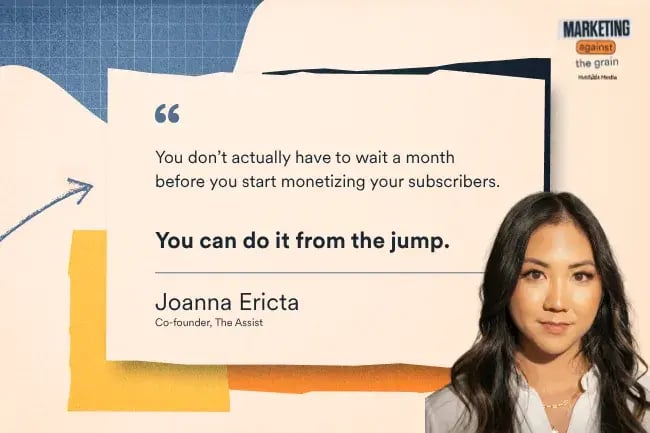
“You don’t actually have to wait a month before you start monetizing your subscribers. You can do it from the jump.”
But monetizing early only works if the audience trusts you. That means saying no as often as saying yes. Recently, a betting platform approached the team. Ericta declined. She’d watched people use it to place bets on the LA wildfires, and she knew her audience wouldn’t engage with it.
“You’ve built so much trust with your audience,” she says. “If you start putting in these random offers that feel totally left field, they’re gonna lose trust in you. And that is way more valuable than the temporary cash.”
Key takeaway: Monetize early. But never at the expense of your community’s trust.


![The Tiny Layout Tweak That Led to 20% More Conversions [Test Results]](https://marketingagainstthegrain.com/hubfs/rebecca-hinton-matg-blog.webp)

![Stop wasting homepage traffic [3 big mistakes backed by 10+ years of data]](https://marketingagainstthegrain.com/hubfs/angela-gomez-matg-blog.webp)


