
Meet the Master

Abrielle Kuo
Partnerships Producer for THE LEAGUE GROUP
Lesson 1: Live isn't just about sales.
TikTok or Instagram Lives work great for sales when you're selling lip gloss.
But if you're in the B2B space, it's far less likely that you'll make a sale from one TikTok Live. But that doesn't mean you should throw the baby out with the bath water.
Lives can still be a strong awareness play. As Kuo puts it, "On a TikTok Live, you don't need to act as a merchant. Instead of thinking you have to make a sale right away, think about how you want to present your brand and how you might build followers."
Kuo likens Lives to YouTube. Your primary purpose is to entertain and grow your audience. Sales is an added perk.
Of course, you'll still want to trust your host to be able to sell your product if the moment seems right. (More on host training later.)
At times, Lives are the QVC of social media, with some businesses making most of their income that way.
If your moderator or producer notices a user viewing a product page, Kuo says that's the host's chance to make a deal. She recommends they say something like, "Mark, I see that you really like our product. If you like it, I can give you $10 off."
Because who doesn't love a discount?
.png?width=650&height=433&name=joy-gendusa-quote_650x433%20(1).png)
Lesson 2: Live is like producing your own TV show.
Kuo tells me one of the biggest mistakes a brand can make is clicking "Record" on TikTok or Instagram without thinking through the purpose of the Live and how they're going to structure their time.
No one needs to hear your social intern rambling on about enterprise SaaS pricing tiers.
"Think about watching television, but it's on your phone. You're actually doing a show. So how do you create entertainment? How do you create that IP everybody's talking about?"
The answer? "You become your own studio."
For bigger brands, this might entail producers, moderators, and camera operators. But you can get away with one person holding an iPhone as long as you still treat it seriously.
That means having a script and making sure your host is trained. Abrielle easily ticks off three things that every host needs: She needs to know the product, she needs to be articulate, and she needs to be entertaining and willing to share a personal story for people to feel a connection with her.
"TikTok has become saturated because a lot of people are going live now," Kuo admits. "So Lives have shifted into a genre that very much cares about expertise."
A few other Live nice-to-haves? Effects and audio. Kuo acknowledges that attention spans are short, so leaning into both visual and audio components can help capture and keep an audience's attention.
Lesson 3: The first 15 minutes are make-or-break.
Speaking of short attention spans…
We've all been on social media long enough to know that pausing the scroll takes serious effort, and is only done if something really seems to warrant it. (In my case, baby goats seem to do the trick.)
For businesses, knowing this behavior is vital.
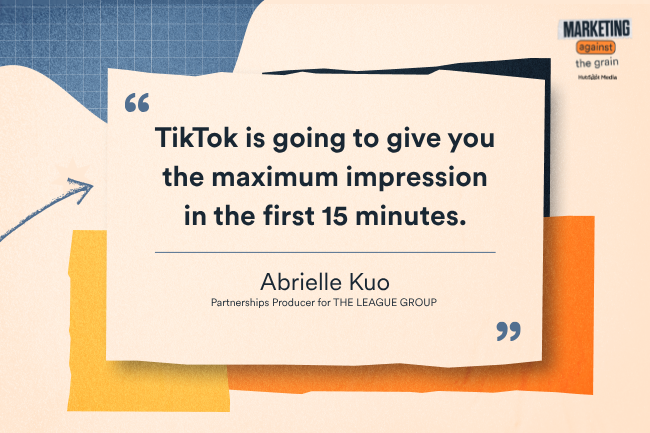
As Kuo puts it, "TikTok is going to give you the maximum impression in the first 15 minutes... [In that timeframe] it's your job to retain those viewers or expand. If you are able to make them engaged, the algorithm will release your show to even more shoppers and viewers."
Fortunately, she doesn't leave us hanging on how to do that. Her tip here is simple: Giveaways.
"A lot of people decide to do giveaways in the beginning because when there's a giveaway going on, I might call my friends and say, 'Hey, there's a giveaway at so-and-so company right now, go visit their Live,'" she tells me.
Bonus lesson: Know what your platform is good at.
To an old millennial like me, TikTok and Instagram Lives feel mostly synonymous.
But Kuo says there's a difference. According to her, IG Lives are more about building an impression and followers, and TikTok Lives are more about GMV and direct sales.
So consider your goal for Lives, and then work backward to pick the platform that best supports it.
Lingering Questions
This Week’s Question
"If you could only open one book for inspiration for the rest of your marketing career, which book would it be?"—Phill Agnew, host of The Nudge podcast
This Week’s Answer
Kuo says: "If I could only open one book for the rest of my marketing career, it'd be "Using Behavioral Science in Marketing” by Nancy Harhut.
What I love about it is that it doesn't just tell you that people behave irrationally, it shows you how to work with that in your content and campaigns. Loss aversion, social proof, the autonomy bias— Harhut takes these principles off the whiteboard and puts them directly into copy, CTAs, and campaign structure.
As a producer, I'm always thinking about what makes someone stop scrolling, stay watching, or trust a brand enough to act. This book gave me a sharper language for that instinct. It helped me understand that the difference between content that converts and content that disappears often comes down to how well you understand the human brain, not just the algorithm.
It's the bridge between behavioral economics and real execution, and I keep coming back to it."
Next Week’s Lingering Question
Kuo asks: "When you're producing a campaign or building creative work with a partner, what's the north star, the thing you protect no matter what?"



![The Tiny Layout Tweak That Led to 20% More Conversions [Test Results]](https://marketingagainstthegrain.com/hubfs/rebecca-hinton-matg-blog.webp)


![Stop wasting homepage traffic [3 big mistakes backed by 10+ years of data]](https://marketingagainstthegrain.com/hubfs/angela-gomez-matg-blog.webp)


