.webp?width=48&height=48&name=BrianneGarrett_Headshot%20(1).webp)
If you ask Tameka Bazile, “you should be able to have your own personal brand, your own life outside of the full-time work you do — and one should not dictate the other.”
With over 60,000 followers across LinkedIn and TikTok, she’s building a community around unfiltered career advice and marketing insights, all while leading social strategy for Business Insider’s B2B division.
Five months into the role, her strategy of “decentralizing visibility” is changing how B2B teams think about transparency, who gets to tell their story, and the role it plays in achieving business goals.
Meet the Master
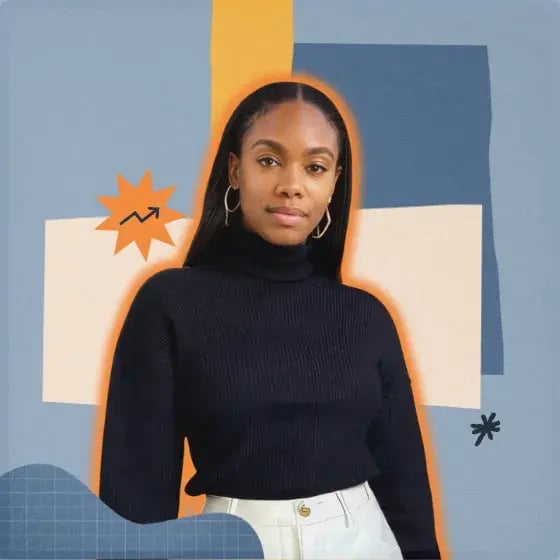
Tameka Bazile
Associate Director, B2B Social & Content Marketing, Business Insider
Claim to fame
Tameka is actively running a six-figure business — while working her full-time corporate role
Lesson 1: B2B marketing needs to lower the gatekeeping.
Many media corporations do little to internally promote what they’re doing on the B2B side, relying heavily on their brand name to attract clientele.
“A lot of the media space is largely gatekept,” says Bazile. “The biggest events, regular people can’t go to them, and the biggest panels are impossible to get into.”
Her role is to lift the curtain. “I like to call it decentralizing our visibility,” she says. By that, she means giving other brands the opportunities to see inside events and other BI activity; it also means reaching and engaging with the entry-level and middle management professionals who are “doing a lot of the footwork behind making some of these major marketing decisions,” but don’t always get a seat at the table.
Less than six months in, Bazile has pioneered the company’s first-ever employee content program, helping executives and team members leverage LinkedIn to increase both their personal career visibility and the company’s B2B presence.
When employees share behind-the-scenes content from events like Davos or client dinners, Business Insider can reach decision-makers in places they wouldn’t typically occupy. Bazile says, “I think the biggest KPI for me is, are we being seen in unorthodox spaces, where you wouldn’t normally expect to see mention of Business Insider?”
A few weeks ago, BI’s sales team attended CES, and several team members naturally took to capturing content on the ground.
“It’s great to really be able to watch people find their own creative lens,” says Bazile. “I think that one of the most exciting parts of my job is really being able to marry that bridge between being a content creator and helping other people leverage their personal brands.”
Lesson 2: Brands need to balance three things: brand presence, cultural awareness, and cultural relevancy.
Bazile is developing a framework (in partnership with HubSpot) to help brands navigate this tension. The key insight: brands should be the adults in the room.
As Bazile puts it, “In the drive to become culturally relevant online, [brands] lose cultural awareness.” We see it often: Brands acting out of character and forgetting who they are in the name of virality.
“In the drive to maintain brand presence,” she says, “sometimes they risk cultural relevancy. In the drive to be culturally relevant, sometimes they throw away the brand presence. And it really has to be a balance of the three.”
Cultural strategists, which she believes are vital positions, should be attuned to the subgroups that exist online and have an understanding of the nuances of social media — like, say, the difference between a trend within a specific community versus one that’s become a broader cultural moment.
“You don’t necessarily have to abandon your morals or your personality or your brand strategy in order to maintain relevancy,” says Bazile. “I think it comes down to knowing your presence as a brand online really well.”
Lesson 3: Your personal brand can strengthen your corporate role — if you take the path of least resistance.
A few years ago, people were getting fired for going viral, but Bazile found a way to bridge both worlds. She built her creator presence around career advice and marketing expertise, creating a complementary relationship and clear boundaries between her personal brand and corporate work.
Business Insider was the first role where they were aware of her being a content creator during the interview process. “It was a part of the conversation, and not a quick footnote.” Bazile’s professional situation represents a broader trend: Companies now recognize that employees with strong personal brands can be assets rather than liabilities.
Her advice for aspiring creator-professionals is to take the path of least resistance by creating content around what they know and what they do well.
“Being a knowledge creator or thought leader really gives you the opportunity to leverage the brand in order to create more opportunities for your career. But then the brand also gets a lot more positive exposure as well. That path of least resistance really creates a lot more opportunity for harmony.”
Lingering Questions
This Week’s Question
“As B2B audiences get more skeptical of polished brand content, how do you see the role of social and content evolving? What should marketers be doing now to stay ahead of that shift?”
—Grace Close, Principal product marketing manager, Reddit
This Week’s Answer
Bazile says: I think the answer here is simple, but the execution and response will be more complicated. Marketers should be prepared to reassess what authenticity, relatability, trust looks like in B2B, and the answer will be surprising.
- Employee advocacy is becoming essential — Your best content distribution isn‘t a brand page, it’s your people. Founders, salespeople, subject matter experts sharing genuine takes will be a key indicator for authenticity and reliability, and brands will need to lower remove the obstacles they've placed between corporate and creator.
- “Unpolished” is the new polished — Raw insights, behind-the-scenes, honest takes on industry challenges outperform slick graphics and case studies. Credibility is key, but marketers will need to learn to say it in layman's terms.
- POV > Information — Everyone has access to the same information. What cuts through is a distinct perspective and application. Marketers need to help their teams develop and share real opinions on their niches, practical applications for how they do their work, and real world scenarios that crack open corporate realities.
Next Week’s Question
Bazile asks: How do you think the economy and job market has affected the freelancing space? Also, what trends are you noticing when it comes to how clients are using websites for their personal brands?



![The Tiny Layout Tweak That Led to 20% More Conversions [Test Results]](https://marketingagainstthegrain.com/hubfs/rebecca-hinton-matg-blog.webp)


![Stop wasting homepage traffic [3 big mistakes backed by 10+ years of data]](https://marketingagainstthegrain.com/hubfs/angela-gomez-matg-blog.webp)

