Whether you think we‘re in our "AI has changed the game" era or "AI has doomed humanity" era, you still gotta know how to make AI work to your brand’s advantage.
So, while we're all praying our ChatGPT prompts were polite enough for our robot overlords to have mercy on us, we surveyed over 200 B2B decision-makers on how they engage with AI search.
Olivia Heller / Marketing Against the Grain
Receipt #1: Buyers tend to trust the robots' judgment.
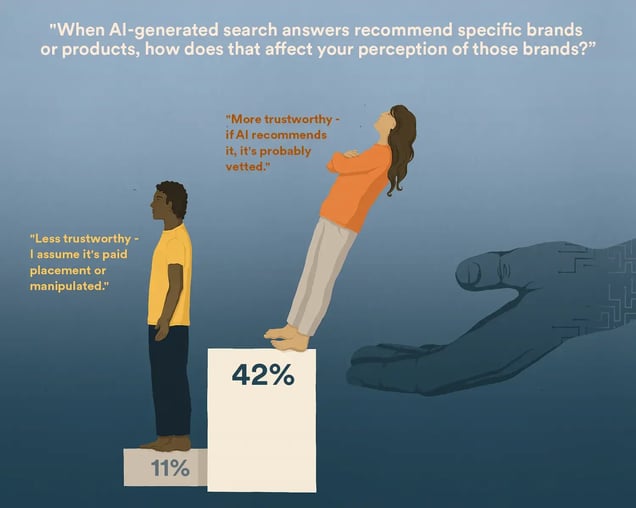
We asked, "When AI-generated search answers recommend specific brands or products, how does that affect your perception of those brands?
- 42% said, “More trustworthy — if AI recommends it, it's probably vetted.”
- 11% said, “Less trustworthy — I assume it's paid placement or manipulated.”
The market isn‘t split between AI search supporters and skeptics — it’s tilted four to one.
42% trust AI to vet companies. They believe it filters the market, fairly assesses options, and surfaces what's most relevant. Its recommendations play as meaningful endorsements.
Their perspective might be off, but it doesn‘t matter. It’s how they experience AI's place in the evaluation process, basically saying, “Due diligence sucks. Let the algorithm handle it.”
The 11% assume commercial interests taint AI answers. And while those buyers may be right, they're significantly outnumbered.
To most, AI search visibility seems honestly earned, not sleazily gamed for.
Receipt #2: Your efforts should be geared toward earning favorable comparisons — not being “the chosen one.”
We also asked, “Think about the last time you saw a brand mentioned in an AI-generated search answer. What do you remember about how it was presented?”
- 40% said, “It was one of several options compared.”
- 26% said, “It was listed as the top or primary recommendation.”
When it comes to buyer recollection, comparison framing dominates primary recommendations by 14%.
Trying to be AI's sole recommendation could be a gamble with a limited payout — betting $50 to win $5.
AI search tools tend to present options rather than singular winners. You can earn top mentions, but singularly favorable coverage doesn‘t align with most buyers’ value perceptions.
Measured comparisons are more prevalent, resonant, and action-driving. 35% of respondents cite favorable comparisons as a primary click driver.
Positive comparisons are also more attainable than hard, “this is it” recommendations. So optimizing to win them aligns with AI search's nature.
Being “better than the alternatives” trumps being “AI's chosen one.”
Strategies like highlighting head-to-head differentiators and offering transparent comparisons help you on that front.
Think, “unlike X, our platform does Y.” That gives AI models clear comparative language to pull from. AI loves when you do the legwork for it.
“What does this mean for…”
Social media
Content that positions your brand relative to alternatives — not just as a standalone solution — is more likely to surface in AI comparisons and more likely to be remembered when it does.
Subscribers who‘ve seen your brand in AI answers arrive with borrowed credibility. They’ve already received an implicit endorsement. Your welcome sequence confirms a perception. It doesn’t create one from scratch.
Paid/performance
The faith buyers have in AI‘s judgment may shift attribution thinking. If 43% trust AI-recommended brands more, a prospect who saw you in an AI answer and later converts through paid may owe part of that conversion to organic visibility you didn’t pay for.
Content/brand
The goal isn‘t to be "the answer" — it’s to be the best option among several. Content that acknowledges alternatives and explains your advantage gives AI material to build comparisons you win.
Original survey data sourced through Panoplai.