
When I got my first full-time marketing job *COUGH* number of years ago, I went looking for a resource to make me a better writer.
What I found was a writer that changed how I thought about both content and conversion.
And now it is with genuine pleasure, and even a touch of giddiness, that I get to share with you one of my own personal, not-so-secret writing weapons…
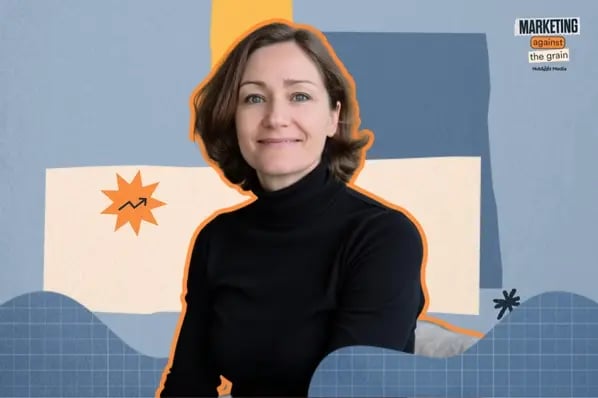
Gill Andrews
Copywriting and conversion optimization consultant, Author of Making Your Website Work
- Fun fact: In her spare time, Gill is the head coach for a U13 soccer team. (Or football club, depending on your longitude.)
“I'm as passionate about it as I am about my work, and you'll find me on the pitch 3-4 times a week.”
Lesson 1: The “Said No Prospect Ever” Test.
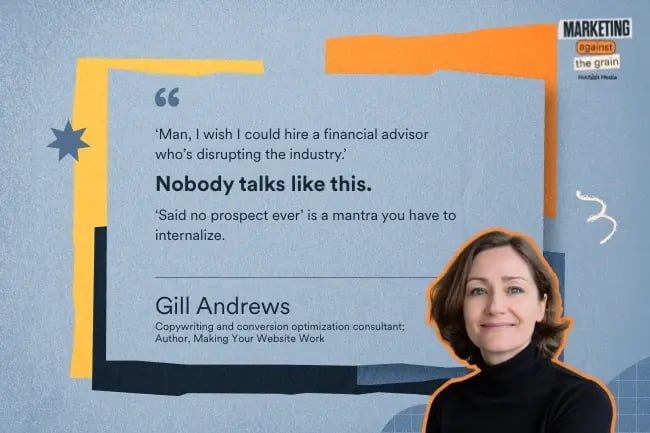
Close your eyes and take a deep breath. Imagine your ideal prospect. She’s sitting at the kitchen table and bemoaning, “Man, I wish I could hire a financial advisor who’s disrupting the industry.”
“NOBODY TALKS LIKE THIS,” Andrews playfully snaps. “I don’t care what you’re doing to the industry. I care what you do for me.”
This is the heart of what she calls her ‘Said No Prospect Ever’ test, and it’s the key to connecting with your audience.
Make my SEO rock. Leverage my synergies. Change my game. Said no prospect ever.
Your prospects are real people. How do real people think and talk about products or services like yours? “What problems are they solving? What are their reservations?” Andrews asks. Go make your website, your product copy, and your marketing reflect that reality.
“‘Said no prospect ever’ is a mantra you have to internalize,” she says. “If you take this lens and go through bloody everything you’re saying about your company, you’ll immediately notice [that] some things just don’t make sense.”
Lesson 2: Don’t waste time dressing up a monster.
“People would not believe how often boring writing overperforms creativity,” Andrews says. “If your entertaining writing isn’t covering the [prospect’s criteria], it will fall flat.”
“It’s like dressing a monster in fun clothes. If your copy has three feet and an arm sticking out of its butt, you can put all the creativity you want on it. It may be super entertaining. You may even go viral for it. But it’s not going to sell.”
Which isn’t to say that creativity should be avoided altogether.
“In some fields, you must entertain to sell. In some, it would be counterproductive. Delight has a place in conversion. If you delight me, I’ll be more likely to buy. If you write me three paragraphs to explain something super simple, I’m not going to be impressed.”
So before you worry about humor or tone or voice, first make sure your writing addresses what your audience came looking for in the first place. Be clear. Then be clever.
Lesson 3: Don’t solve hypothetical problems.
“Don’t bring your opinion to a data fight,” Andrews says about optimizing your web presence. “And don’t try to solve hypothetical problems.”
She gives the example of a website tagline that fails to resonate. You could spend months guessing at new copy, only to find that your audience never cared in the first place. Or you can run audience surveys, heatmaps, A/B tests, etc., right from the start.
Similarly, once you have identified a real problem with your copy, don’t just guess at better wording. I asked her — other than reading her book — how marketers can do better at this.
“You can’t just sit in your house and think in your head and suddenly become smarter. You need to get your theory from somewhere. Type [your problem] in Google search and see what comes up. And after you’ve learned about 10 problems, you’ll start recognizing patterns.”
Then a wry grin spreads, “And I guarantee you, for some problems, my book will come up in search. But what are you going to do?”
Bonus lesson: Meet your heroes.
Since Andrews is one of my writing heroes, I asked her who her writing heroes are.
“I have one hero,” she laughs. “Joel Klettke. I’ve never met him in person, but we wrote a couple of times years ago. I don’t hope that he’ll [read] this, but in case he does: Joel. Wow. You read his copy and he’s such a smart and funny person, but he also covers every point that needs to be covered. It’s this efficiency in the amount of value per word.”
So, Joel, if you’re out there… Gill says hi.
Lingering Questions
This week’s question
“How do you think the economy and job market has affected the freelancing space? Also, what trends are you noticing when it comes to how clients are using websites for their personal brands?” ~ Tameka Bazile, associate director of Social & Content Marketing for Business Insider
This week’s answer
Andrews says: I don't have a bird's-eye view of the freelancing space. My main source of information is a relatively small bubble on LinkedIn.
But it does seem that the way freelancers generate leads has changed dramatically because of AI. Some lost clients directly to it. Some lost organic visibility because of how search works now. Some lost visibility on social networks, which are flooded with polished content produced at scale with AI.
Many things that used to work simply don't anymore, and a lot of freelancers are still trying to figure out what does, while struggling to find clients in the meantime.
From what I see, [personal websites are] being used the same way they always were: as a trust signal and a place where your credibility, personality, and offer all come together in one spot, as well as a lead generation tool.
I don't see this changing soon for service-based personal brands (consultants, coaches, copywriters, etc.). Their personality is a big part of what they're selling. And you can't get a feel for someone's personality from an AI summary or a chatbot recommendation.
Next week’s question
Andrews asks: If you could make everyone in the world know or understand one thing, what would that be?



![The Tiny Layout Tweak That Led to 20% More Conversions [Test Results]](https://marketingagainstthegrain.com/hubfs/rebecca-hinton-matg-blog.webp)


