
As organic traffic shrinks, the field of competitors grows, and the void you’re shouting into feels… void-ier?
If you’ve ever had a piece of content you were proud of die in obscurity, this story is for you.
Today’s feature is about how our podcast team turns every collaboration into its own distribution channel. And how, instead of doing more with less, co-marketing can help you do more with what you’re already doing.
Doing more with what you’re already doing.
“One of the biggest challenges with podcasting is that search and discoverability are really difficult,” says Carly Baker, head of Media Partnerships for the HubSpot Media Network.
No matter what channel you’re working in, you’ve probably made the same complaint, accompanied by a long, dramatic sigh. But the difference is particularly noticeable for podcasters.
Once upon a time, you could build up a respectable audience just by inviting guests that your prospects already recognized. Now that everyone and their grandma has a podcast, it’s not that easy anymore.
But Carly is even sharper than the shoulder pads in her headshot. She realized that if a guest is recognizable to your audience, they probably have a ready-made audience of their own. But how to get them to share?
“We had to get creative about how we were asking [guests] to work with us to ensure that we were not only reaching our audience, but also leveraging their audience and their reach.”
The resulting process led to a 15% increase in subscribers and an average 43% conversion rate from guest landing pages.
Here’s the five-step strategy she uses to get collaborators to share content (nearly) every time…
Putting the Co in Co-marketing
Step 1: Ask at the outset.
"The most integral part of actually getting this tactic to work is bringing up the co-marketing conversation at the start," Carly says.
She slips this naturally into the editorial intake process.
“For a long time, we’ve had a Google form that covers things like: How do you say your name phonetically? What would make this conversation a win for you? Don’t use this type of headphone.” This sort of boilerplate form is expected for interviews. “We thought, we’re already going to send them this form — why don’t we include information about audience amplification?”
That includes both what you will do and what the guest will do. But Carly cautions that the way you position the conversation is absolutely critical.
“You don’t want to say to a potential guest, ‘If you’re unwilling to share this with your audience, we’re not going to let you come on.’ We position it as ‘We want to ensure that your episode reaches as many eyes and ears as possible. Here are all of the ways that we’re going to distribute this episode on our own channels. We would love your help in making sure that this episode reaches your audience. Where can you share this episode?’”
The form then offers a list of checkboxes for platforms like LinkedIn, TikTok, YouTube, etc.
As a secondary benefit, getting this information up front will cut down on your work later in the process. But we’ll cross that bridge in a few minutes.
First, you have to do the interview…
Step 2: Create a thoughtful editorial experience.
"If they have a bad editorial experience, if they're not happy with the episode, they're not going to share,” she shrugs. “It has to be a 360, holistic experience, at every single touchpoint that they have with the booker, the producer, the talent, the post-interview."
Thankfully, your super-thorough intake form also included questions about what they’re passionate about talking about and what would make a positive experience.
“We’re optimizing to make sure we’re putting together an episode that they’re really excited to share and feel like their audience is going to love.”
Step 3: Provide a custom asset package.
Now, here’s the part most marketers miss: You give them something to share.
“You have to make it as frictionless as possible. Everything is optimized for them to just download and immediately share. If we want them to share, we have to give them everything they need to just copy and paste and post.”
For each interview, Carly offers guests a custom asset package that includes:
- Thumbnails that feature the guest.
- Three short-form clips.
- Static images pre-sized for social media.
- Social media copy.
- A transcript with time stamps for key moments.
- Episode descriptions.
- Positioning and language recommendations.
If your eyes are watering thinking about all that work, dab your tears away, because Carly has two tips.
First, this is why your intake form asks specifically where they will share your content. Don’t bother making TikTok videos if they’re only going to share on LinkedIn.
And second: “Are we allowed to talk about tools?” she cautiously probes. Hell yeah, you are!
“Okay, cool. I would recommend a tool that we use called Castmagic. You basically upload a file directly to the platform — you can even upload a YouTube video — and it will create a lot of the assets for you.”
(Now, my standard disclaimer: Castmagic is not affiliated with HubSpot, and this is not a paid ad or partner placement. Carly really does use Castmagic.)
Step 4: Say thank you.
“We'll send a follow-up email — we try to send it on the same day — saying, ‘Thank you so much for being a guest on the show, we really appreciate it.’" But this is not just about being polite. The follow-up email should also confirm:
- When and where the episode will go live.
- When you’ll be sending them the assets.
- When and where you’ll be promoting the assets yourself.
- When and where the guest agreed to promote the assets.
And then, the key piece of the puzzle: "I would love to amplify your posts — send me the links when they're live and we'll share with our audience."
This sets the expectation that your guest will tell you when they have fulfilled the promotional agreement, but shows that you’ll be supporting them, not policing them.
Step 5: Engage with the guest’s posts.
“Always give a like and leave a comment. Something as simple as, ‘Loved having you as a guest! Thank you so much!’ You can also repost it or share it to your story.”
This not only cements a positive relationship with your collaborator, it also encourages the platform’s algorithm to push the content.
But what if they share someplace they own, like their newsletter, podcast, or YouTube channel?
“You can always screenshot that and share it on your own channel, and take those things from being a closed ecosystem share to an open ecosystem share."
How to do co-marketing right.
As with all marketing, there are lessons you usually only get when things go very, very wrong. Luckily, Carly’s willing to share tips she’s learned from working with hundreds of guests.
Elevate the guest.
Part of your job throughout this process is to make your guest look good. That’s what’s going to make them follow through.
“Elevate them as a speaker and provide value to their audience. It’s a distribution tactic for you, but it’s also giving them content that’s custom created for them.”
Ask for a feed drop.
"A feed drop is where you take your episode featuring this guest and put it on their own [podcast or video] feed."
They get free content. You get direct access to their audience.
"The way this works best is if you get the guest to do a custom introduction. ‘Hey, I was a guest on Curt’s podcast. We talked about these three things. Here’s why it’s relevant to you.’ Having them do a custom intro is important, because otherwise there's suddenly just a random episode from some other show and the listener doesn't know what it is."
Mirror your existing strategy.
A lot of the work you’re doing anyway can become a promotional asset. And many times, it’s okay if their content is identical to yours.
A good example is an episode description. You already need to write one for your platform, but your guest can also use that as lazy social copy.
"There are things that you might not think about that you already do for yourself that sort of fit into that asset category and would be helpful for a guest."
Use co-marketing as audience research.
It’s obvious that audience reaction will tell you how well the content was received, but it can also inspire new content, as well.
"If you have a ton of people from their audience who are commenting specific follow-up questions or specific topics that were mentioned, that's a great way for you to do editorial research."
Track everything.
"Podcast attribution is notoriously very difficult across the board," she says. “For our own tracking purposes, we give guests unique UTMs, so we’re able to see traffic, data sources, and how much their audience is engaged on the backend.”
You should also track the number of likes/comments/shares/subscribers that are gathered by which guest and on which platform.
“We like to use a tool called Linkfire. You can see on the backend data and analytics about how people are engaging. If they’re listening through YouTube or Spotify or Apple, etc..”
(Another disclaimer: Linkfire is also not affiliated with HubSpot. Not a paid ad. Not a partner placement. Yadda, yadda, yadda.)
Offer alternatives.
Even if a guest has agreed to share, is happy with the content, and you’ve made it easy for them to promote it, it’s not a guarantee that they will do so.
People get busy, or forget, or have a change of heart.
If this happens, Carly says it’s important to follow up, but not to be accusatory. Instead, keep a helpful tone: “Is there a better asset, or some other part of the conversation that you would want to clip from? Or is there anything else that we can do to enable you to share?"
Make it form-al.
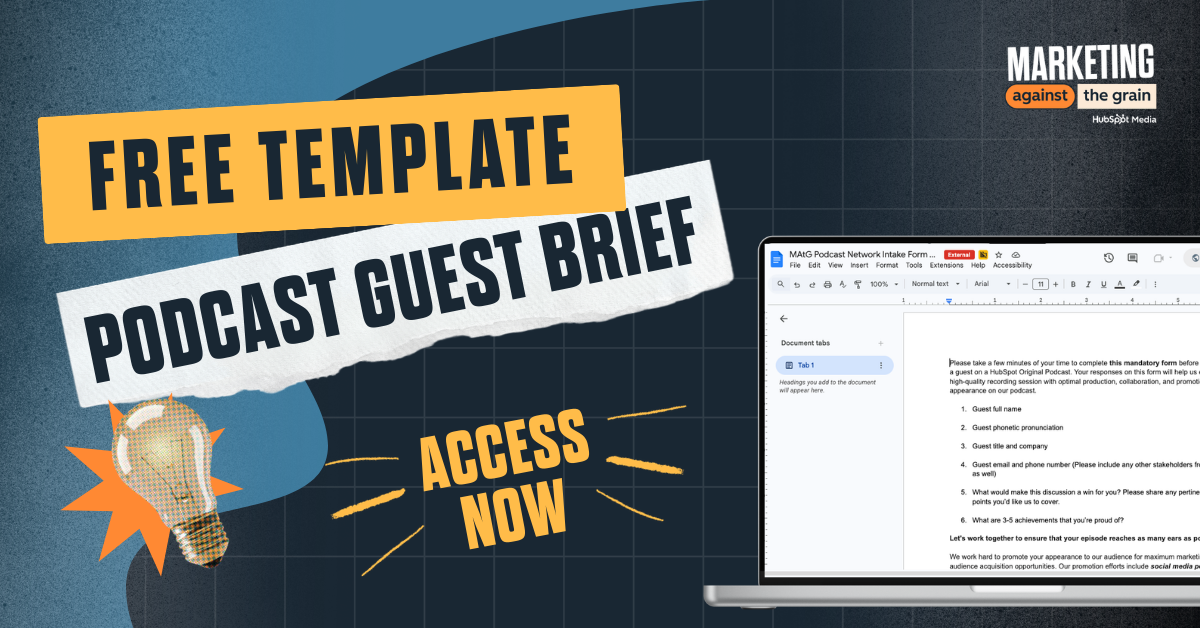
Carly put a lot of blood, sweat, and tears into refining her intake form, but she’s generously volunteered to share her template with you. (All blood, sweat, and tears have been cleaned off.)
You can use this as a guide for creating your own in Google Forms, Jotform, or hey, HubSpot’s free form creator.


![The gentlemen’s agreement that netted 210,000 subscribers. [Steal this play.]](https://53.fs1.hubspotusercontent-na1.net/hubfs/53/matg-mfm-gentlemans-agreement-graph-email.jpg)
![How we turned a YouTube traffic crash into 22% more views [+ free resource]](https://marketingagainstthegrain.com/hubfs/nelson-chacon-guzman-matg-blog.webp)


.png)
