.webp?width=48&height=48&name=BrianneGarrett_Headshot%20(1).webp)
Taylor runs Nuclei (and powers its creative strategy) while still consulting for other brands (her portfolio includes Amazon, Nike, Topicals, and Essence). These days, the Forbes 30 Under 30 alum often trades strategy work for equity in lieu of a flat fee and is also “in her angel investing era” for a few aligned beauty brands.
Her multiple hats as an “etcetera creative” have made her a stronger marketer and business person. "I think that we shouldn't be looking at these titles as labels," says Taylor. "I think that we should be looking at them as different gears." A title, in other words, isn't a fixed identity. It just reflects where you are in the process at a given moment.
Here's her advice for marketers in it for the long drive.
Friday Feature

For Taylor, everything starts in first gear, or what she calls "artist mode": doing something purely because you believe in it. Skip that gear — try to build a brand or sell a product before you've actually sat with it, for example — and the engine is in danger of burning out.
Point of view over performance
One of the biggest ways Taylor believes creators and marketing teams burn out is by trying to maintain contrived versions of themselves for the sake of the algorithm. "A lot of people are trying to perform identities before they have lived in it themselves," says Taylor. "You don't even know what you genuinely like, but you know what's going to perform well."
That's the trap, in her view: chasing what gets a reaction over what's actually true and tested by you, then building an entire persona on top of it before you've tested whether it's real.
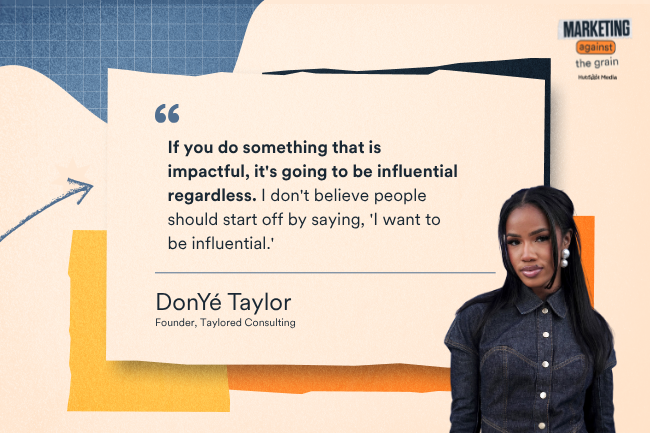
It's also why Taylor resists chasing influence as a goal in itself. "If you do something that is impactful, it's going to be influential regardless," she says. "I don't believe people should start off by saying, 'I want to be influential.'"
Key takeaway
Visibility is a great byproduct of doing the work. But without a true point of view, it's not sustainable.
Community marketing often means solving your own problem first
Taylor started her Substack years ago, right after quitting her full-time job, mostly because she needed somewhere to put the feelings that came with entrepreneurship. People recognized themselves in it, and it grew into a community.
For Taylor, that's the actual definition of community marketing: serving your community's problem by being honest about your own first. When you do this, "People don't just know what it is that you sell, they understand what it is that you stand for," she says.
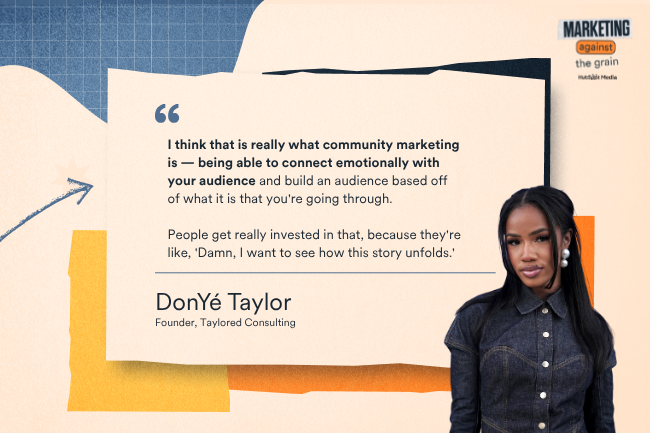
The same logic applies for businesses without a big marketing budget: lean into resonance. "I think that is really what community marketing is — being able to connect emotionally with your audience and build an audience based off of what it is that you're going through," adds Taylor. "People get really invested in that, because they're like, 'Damn, I want to see how this story unfolds.'"
Key takeaway
Audience-building that eventually converts to customers comes naturally when you're honest about your own experience before you ever try to monetize it.
Creative direction is not marketing
Taylor spent a year on a matcha candle, sourcing, testing, getting the packaging right. She initially leaned hard into an influencer casting and campaign build for the launch. It underperformed.
“I feel like it was too high production," says Taylor. So she started making her own videos — talking plainly about her relationship to matcha and why it mattered to her creative process.
It's the same lesson she had learned earlier with Nuclei's brain banks, which generated 200 orders on launch day, then three the next. "So many people buy based on energy," she says. Keeping that energy up means continuing to show up and talk about the product in public, which she admits takes practice. "Talking about yourself and saying that you want to sell something is a bit cringe," Taylor adds. But she's made peace with it.
"First it's cringe, then it's respectable," she says, "because it's like: she's disciplined, she has a vision, she is consistent."
Key takeaway
A beautiful campaign isn't the same thing as a sales strategy. Sometimes the unpolished, personal approach is often the one that actually converts.