
Erin Reddick has a tool that could have saved American Eagle from backlash over last summer’s “good jeans” campaign — in under 30 seconds.
I talked to Reddick, who’s the founder and CEO of ChatBlackGPT, a custom GPT that has been trained on data and lived experiences that center Black perspectives. She designed ChatBlackGPT to provide culturally aware insights into just about anything, she says — including the impact of your next marketing campaign.

She also told me why, in a world that already feels saturated with AI tools, she created it, and whether “ethical AI” is really possible.
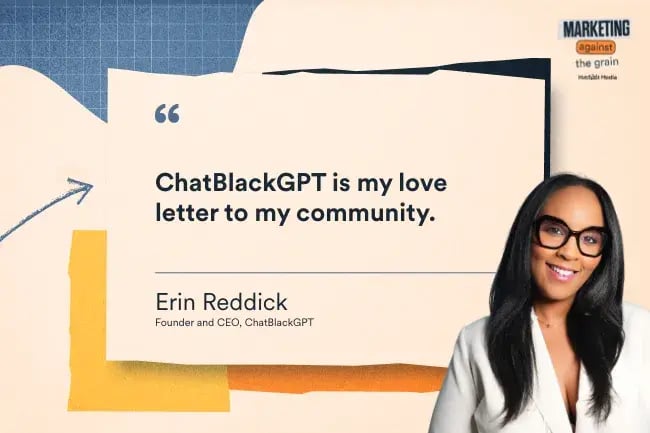
Erin Reddick
Founder and CEO, ChatBlackGPT

Tools can’t replace real representation — but they can help surface knowledge gaps while teams grow.
“I put in the Sydney Sweeney [“good jeans”] ad,” Reddick says of ChatBlackGPT, “and it literally listed every single thing that was happening [in the online discourse]. And it was like — that could have been avoided. And it's really not hard to do.”
Here’s how Reddick suggests marketers can evaluate patterns of cultural insensitivity in their campaigns:
The Cultural Sensitivity Test
Give it this data
Five campaigns that received criticism from Black communities and other historically marginalized communities.
Use this prompt
Review this content and identify any language, imagery, or messaging that could be harmful or alienating to a Black audience. Rate the potential impact from 1-10 and explain why.
Reddick told me that building ChatBlackGPT is her “love letter to my community.” But “I operate as a host, not a hero,” she says — in other words, she has no desire to tell people how to use her tool. “I’m designing something that is truly for the benefit of the person. It’s really just perspective sharing.”
“Let's say that somebody is curious about Black people or Black culture. Instead of asking the person directly, they can ask this tool.”
The Audience Assumption Test
Give it this data
Any content and assets from a campaign you’re working on, plus information about your existing and/or target audience(s).
Use this prompt
Identify assumptions about income, education, geography, or access that may exclude marginalized audiences.
We all have implicit biases, but it’s easy to forget just how hard it is to identify them (hence the “implicit” part).
So when I asked ChatBlackGPT to review an early draft of this newsletter, it noted a couple of assumptions I hadn’t thought of: that readers would have access to multiple AI tools, and that our readers would have access to historical campaign archives (which might exclude freelancers, solopreneurs, or early-stage founders).
This prompt can be especially helpful as you’re defining your ideal customer profile (ICP), so you can challenge your assumptions before you codify them.
If you want a more specific critique of your campaign, try the next prompt.
The Comparison Test
Give this data to both ChatBlackGPT and another AI tool
The newsletter draft you’re currently writing.
Use this prompt
Review this newsletter draft through a culturally aware lens, centering Black readers and other historically marginalized communities. Identify language that may unintentionally reinforce stereotypes or Eurocentric norms, and show me opportunities to include diverse perspectives.
I told Reddick that most of our readers worked for small- and medium businesses. Especially in organizations working toward more inclusive hiring practices, she suggests using her tool to get a Black perspective on, well, just about anything.
I asked both ChatGPT and ChatBlackGPT to review this newsletter draft, and while both had some good suggestions, ChatBlackGPT went into far more detail.
Initially, I had suggested that for the cultural sensitivity test, users could provide data on “five campaigns that performed poorly with diverse audiences over the last five years.”
ChatBlackGPT gently pointed out to me that “‘Diverse audiences’ is vague and often defaults to ‘non-white.’”
The Final Word
“Marketers should focus on tool-building skills,” says Reddick. “It's easier than you think. As a marketer, you're likely to have artifacts of your own work, your own copy, your own campaign designs. You can use AI to analyze your style, your voice, your strengths, your weaknesses.”
And as for whether AI can be ethical? “I think it's ethical to acknowledge the truth,” she tells me. “So that’s how I’ve centered the way I designed and built it.”
Count me among the content marketers now actively trying to expand my cultural lens.
ChatBlackGPT is in beta, and you can use it here.


![The Tiny Layout Tweak That Led to 20% More Conversions [Test Results]](https://marketingagainstthegrain.com/hubfs/rebecca-hinton-matg-blog.webp)


![Stop wasting homepage traffic [3 big mistakes backed by 10+ years of data]](https://marketingagainstthegrain.com/hubfs/angela-gomez-matg-blog.webp)


