It started as a joke in a TikTok comment section.
Laura Cameron noted that the industry has conflated the different roles across social, PR, advertising, and marketing. A back-and-forth in the comments looking for a solution turned into a new acronym: "SPAM."
Cameron thought the experience and newly coined acronym was compelling enough to make a video about. She posted it on a Friday, stayed off social media for the weekend, and when she checked back Sunday night, it was viral.
This was back in May (yes, two months ago).
What's followed in the very brief time since has been fun merch, a nearly 5,000-person LinkedIn group, and the early stages of exploring in-person events. (One dream collab: An actual partnership with SPAM, the tinned meat brand. "I don't know what the trademark rules around that would be," Cameron laughs, "but that would be really cool.")
Meet the Master

Laura Cameron
Founder, Women in SPAM Network
Claim to fame: A joke in a TikTok comment section turned into a global movement that’s already generated press mentions by outlets like Vogue. And she’s building it all while working full-time in PR.
Lesson 1: Let the community set the roadmap.
Cameron proclaims herself as the founder of the Women in SPAM Network, but "I don't want to own it," she says. She looked into trademarking the name and walked away after talking to a lawyer, accepting that no one "owns" a term like this; same goes for similar ones like Women in STEM.
That's not to say she isn't deciding what gets built next, but she's doing it by letting the community guide her. When the account first took off, Cameron was flooded with DMs from people wanting to get involved, far more than she could respond to. So she posted a poll on the LinkedIn community page asking people to weigh in with what they wanted Women in SPAM to become. Events and merch came out on top, so that’s what she focused on first.
She’s also encouraging members in cities she can't reach personally, from Chicago to Sydney, to run their own local events under the same banner. She founded the community; she just doesn't want to be its gatekeeper.
Lesson 2: Polished is working against you.
Cameron’s TikTok presence had already centered her day-to-day in marketing and commentary on the industry — long before Women in SPAM existed. Since SPAM kicked off, other brands have been reaching out to work with her, which she largely attributes to establishing a point of view from the start, one inseparable from her own personal brand.
"A lot of brands... are saying, 'We love this community, we love this idea,'" she says. Rather than asking for a standard ad placement, they're asking her to fold the SPAM community, her included, into the campaign.
Beyond Women in SPAM, Cameron thinks brands leaning into everyday people via UGC are the ones thriving in 2026. "I prefer videos that don't look polished,” she says. “I'd rather it look like someone shot it on their iPhone and is genuinely using the product or the service, and that it fits naturally into someone's day."
Lesson 3: Play the long game.
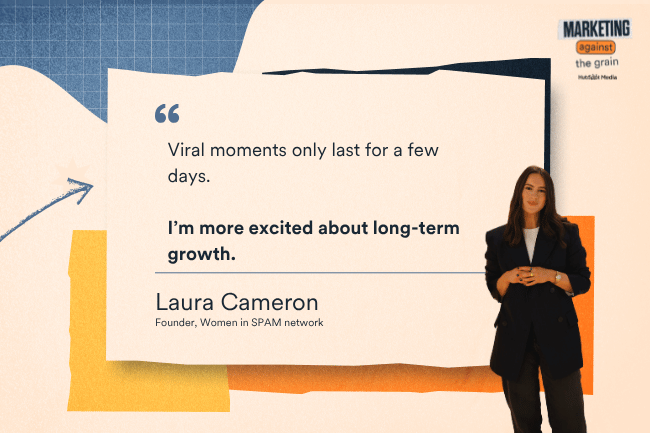
There's a natural adrenaline rush when the concept you launched goes viral, but "viral moments only last for a few days," says Cameron. She's more excited about Women in SPAM's long-term growth.
Its premise may have stemmed from a joke, but its mission is rooted in changing the narrative around what women in this industry actually do. "Probably 50% of my day is working on some social stuff for my clients," Cameron says of her own PR role.
"Another part of it would be working on ads. A big part of it is working on marketing." The SPAM acronym hits close to home for her; she's part of a community tired of having its work minimized or misunderstood.
"More and more, my job is to look at metrics, to look at ROI, to report back on data," she says. "There is science to it."
Building SPAM alongside a full-time job hasn't been without cost — "there has been a meltdown or two," she admits — and she's the first to say she's figuring it out as she goes. Still, Cameron doesn't think an idea needs a fully formed plan before it's worth trying.
"Just get it out there," she says. "See what happens."
Lingering Questions
THIS WEEK'S QUESTION
What's one marketing belief you held early in your career that you've completely changed your mind about?
—Natalie Holder, Marketing campaigns and performance manager, Angel City FC
THIS WEEK'S ANSWER
Cameron says: Early in my career, I thought every piece of marketing/PR needed to appeal to everyone. Now I believe the opposite.
The best marketing is often specific enough that some people won’t relate to it at all. When you understand your audience deeply and speak directly to them, you create much stronger engagement than trying to be universally appealing.
I always say you need to be uncomfortably close to your ICP. What stresses them out? What problem do they need fixing? What did they have for dinner last night (ok, maybe not that close!). That’s true whether I’m running a B2B campaign or creating content on my own channels. Question number 1 is always: Who am I targeting?
NEXT WEEK'S LINGERING QUESTION
Cameron asks: What’s one thing marketers overcomplicate that could actually be much simpler?