
Where most marketers pad, Grace Wells deletes.
She’s built a following of nearly 4 million across channels, and she did it by mastering a skill that too many of us ignore — knowing when to stop.
Meet the Master

Grace Wells
Commercial video creator and Founder, Product Film School
Fun fact: She produced an ad for a major pharmaceutical company for less than your company’s last offsite — under $10k! — and it ran on TV for over a year.
Lesson 1: Trim the fat.
Even if you don’t know Grace Wells by name, you probably know her from her signature video intros.
“The way that I introduce all my videos is by reading a comment, and then I’ll cut mid-sentence into the meat of what I’m doing behind the scenes,” Wells explains.
Of course, it took time to establish that. But now, she says, “the audience knows where I’m going with this. I don’t even need to finish this sentence before I jump into the next shot.”
“What that’s taught me is that as soon as you’ve reached the moment where the audience understands the purpose of this shot, or this line of dialogue, or this piece of copy — as soon as there’s that recognition and understanding — you move on right away and don’t linger on anything.”
Lesson 2: Your camera is the least important thing on set.
In 2024, Wells launched Product Film School to teach budding video creators what she’s learned about product advertising on a budget. “Creators will often prioritize the wrong things,” she tells me. “Like, people place way too much emphasis on what camera to use.”
And that’s actually not as important as you might think. Even Olivia Rodrigo shot a music video on an iPhone 15 Pro (“get him back!”, and it’s a banger).
“The bigger priority is making sure that you have really great lighting,” Wells says. “That is the make-it-or-break-it thing for me.”
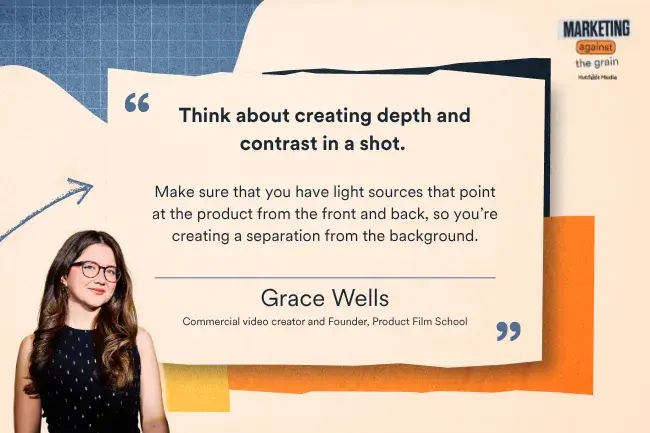
If you want to get really granular, think about “creating depth and contrast in a shot,” she suggests. “Make sure that you have light sources that point at the product not just from the front, but also the back, so you’re creating a separation from the background.”
In her Product Film School, Wells also emphasizes the importance of having a point of view, even for a short product video. What you’re creating has to actually say something, she says, even if it’s a 6-second looping reel. ”You can have that visual piece where you’re making the product look really beautiful, but if you’re not saying anything, then that content is going to fall flat.”
Lean on your narrative devices, Wells says. Maybe the video shows how a product solves a particular problem. “Or maybe we present the product as a sort of enigma at the beginning of the video — there’s a mystery to uncover about the product and then we solve that mystery.”
“Lighting and storytelling are not things that require budget. They are really just foundational skills that you can cultivate to help you produce really great content, even if it’s just with a couple of lights, a backdrop, and a few props from Michael’s.”
Lesson 3: Make your ad look like it already lives there.
Wells tells me about a piece of content she created for a wellness brand with a very nature-inspired aesthetic. Normally, she says, you’d expect elements like neutral colors and other things that convey tranquility and calm.
But the internet is anything but tranquil and calm.
So Wells took the wellness blueprint and added visual digital elements that Instagram or TikTok users might expect — “we had cursors moving through the frame and hovering over the product, a pop-up that shows the brand and a messaging point,” and other elements that felt native to online platforms.
“Anything that you can do to integrate the infrastructure of the platform will make it feel more organic to the world in which people are watching it,” Wells explains. “It’s part of the fabric of your feed as opposed to this cutaway.”
Next time you’re scripting a social ad, ask yourself what that platform’s furniture looks like — and borrow some of it for a lived-in, organic feel.



![The Tiny Layout Tweak That Led to 20% More Conversions [Test Results]](https://marketingagainstthegrain.com/hubfs/rebecca-hinton-matg-blog.webp)


![Stop wasting homepage traffic [3 big mistakes backed by 10+ years of data]](https://marketingagainstthegrain.com/hubfs/angela-gomez-matg-blog.webp)


