
Everything you know about building a brand is exactly what could tank your next paid newsletter ad.
Newsletter growth consultant Manny Reyes explains why — and he’s got six years of data to back up his hot take.
Meet the Master
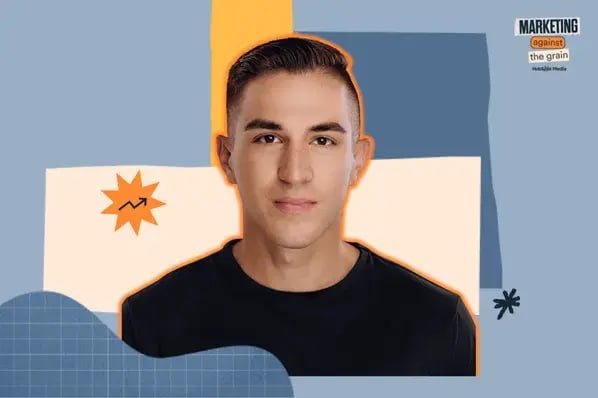
Manny Reyes
Founder, Boletin Growth
Claim to fame: Manny has consulted on dozens of high-performing newsletters — including the one you’re reading right now.
Fun fact: He ran paid newsletter growth for James Clear (of Atomic Habits fame) and got the cost per subscriber down to $0.80.
Lesson 1: Your brand’s presence in an ad can actively hurt performance.
You’ve worked so hard to perfect your brand colors, your logo, your entire visual identity. So Reyes’ first lesson is gonna feel like a punch to the gut: Don’t use ’em. At least not in your new Instagram ad spot.
If you put two ads side by side, one with your full visual identity and one without, Reyes tells me that he’d bet “a large chunk of my 401k” on the ad that doesn’t have your logos, brand colors, and fonts.
I admit I’m a little bit skeptical.
“I have six years’ worth of data,” Reyes assures me. “It’s going to perform worse.”
An ad for your newsletter is funneling free value into people’s inboxes, he explains. “There’s not an emotional tie to the brand.”
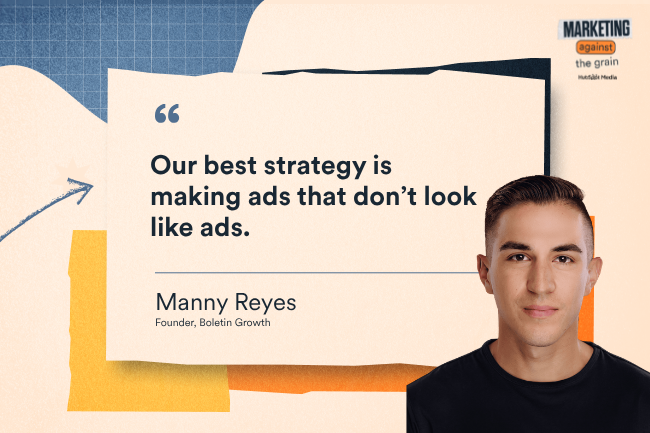
If a Morning Brew ad promises to make you smarter in five minutes a day, it doesn’t need to come wrapped in Morning Brew brand colors to deliver on that promise. “Our best strategy is making ads that don’t look like ads,” and that often means letting go of your brand’s look and feel.
So swallow your brand vanity for a moment. Stop the scroll with great ad copy and great visuals that target your very specific audience, so that high-intent users are self-selecting and hitting the “subscribe” button.
Lesson 2: Meta ads work even for B2B audiences — because everyone has Facebook or Instagram.
Reyes’ business is built entirely on using one ad platform: Meta. That’s because it works, and because the costs are reliably low. If your total addressable market is small, Reyes might see a cost of at least $4 - $5 per subscriber, but he’s gotten it to under $1 for some clients.
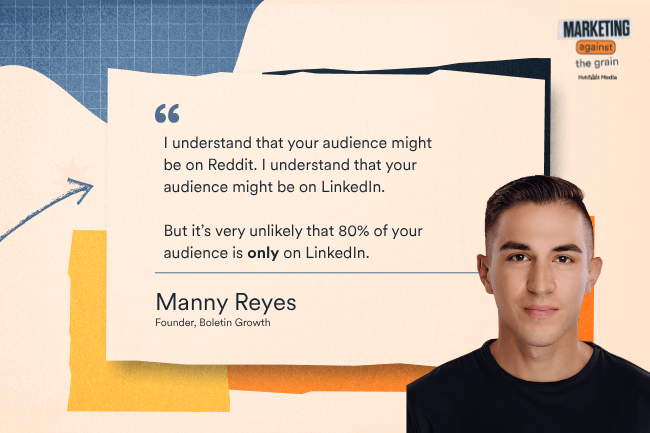
“I understand that your audience might be on Reddit,” Reyes says. “I understand that your audience might be on LinkedIn.” But LinkedIn ads might cost you $20 - $30 per subscriber, and, as Reyes explains, “it’s very unlikely that 80% of your audience is only on LinkedIn.”
For his clients, “We don’t do a ton of lookalike audience targeting or specific niche-based interest targeting. We let the algorithm do the targeting.”
At this point, Reyes says, “Meta is very good at understanding who [your ad] is for, putting it in front of users, and learning from the data.”
Instead, the targeting is all in the creative, like ad copy that’s extremely specific to an audience.
Lesson 3: Don’t confuse a test budget with a real benchmark.
If you’re just dipping your toes in the paid growth waters, you should reset your expectations as you scale up.
Say you spend $500 - $1k on your first Meta ad and get new subscribers for about a buck each. You might be tempted to throw more money at it, expecting to get more subscribers at the same cost per acquisition. Hold your horses.
“Do not expect those same results in month two when you want to spend $5k or $10k or $20k,” Reyes says. “Meta is a beast.”
“If you tell it to spend $500 today, it will gladly spend $500 every single day,” says Reyes, but that means it’s spending your money on lower-quality audiences — because it’s exhausted the high-intent ones in your budget. And suddenly your cost per subscriber starts creeping up.
If you’re not careful, Meta ads will become a cash-burning mechanism rather than a growth mechanism, Reyes cautions. “I’m not saying that your CPA is going to 3x or 4x — but it’s going to increase, and you just have to make sure you keep producing creative.”
His suggestion? Net new creative — new hooks, new copy, new visuals — every single week.
Lingering Questions
This Week’s Question
Won’t paid subscribers be lower quality than organic ones? How do I know they’ll actually open my emails and buy?
—Matt McGarry, Founder and CEO, GrowLetter
This Week’s Answer
Reyes says: For the past six years, it’s been the industry standard that paid subscribers, on average, are a “lower quality” cohort than organic ones — but mainly when it comes to engagement metrics like open rate and CTR.
Accurately predicting whether they will open your emails is 20% making sure that your ads aren’t misleading them, and that you’re delivering on your promise. But 80% is what you do on the backend: Did you set up a strong thank you page, strong welcome email, and strong email sequence to convince them to buy? Did you include strong CTAs at the bottom of your newsletter to give them a chance to buy your offering? etc.
Next Week’s Lingering Question
Reyes asks: If all other newsletter metrics were banned and newsletter operators could only keep two to track for the rest of time, which two metrics would they be?

![The Tiny Layout Tweak That Led to 20% More Conversions [Test Results]](https://marketingagainstthegrain.com/hubfs/rebecca-hinton-matg-blog.webp)

![Stop wasting homepage traffic [3 big mistakes backed by 10+ years of data]](https://marketingagainstthegrain.com/hubfs/angela-gomez-matg-blog.webp)


