Readers who recently checked the news after waking up from a four-year coma, I’m sure you’re thinking two things:
1. “Ahhhhhh!”
2. “Holy cow! AI is everywhere.”
It’s changed everything, especially how buyers engage with search engines — and marketers are still adjusting.
That’s why we surveyed over 200 B2B decision-makers on their AI search preferences.
 Olivia Heller / Marketing Against the Grain

Receipt #1: Trust and action are driven by different signals.
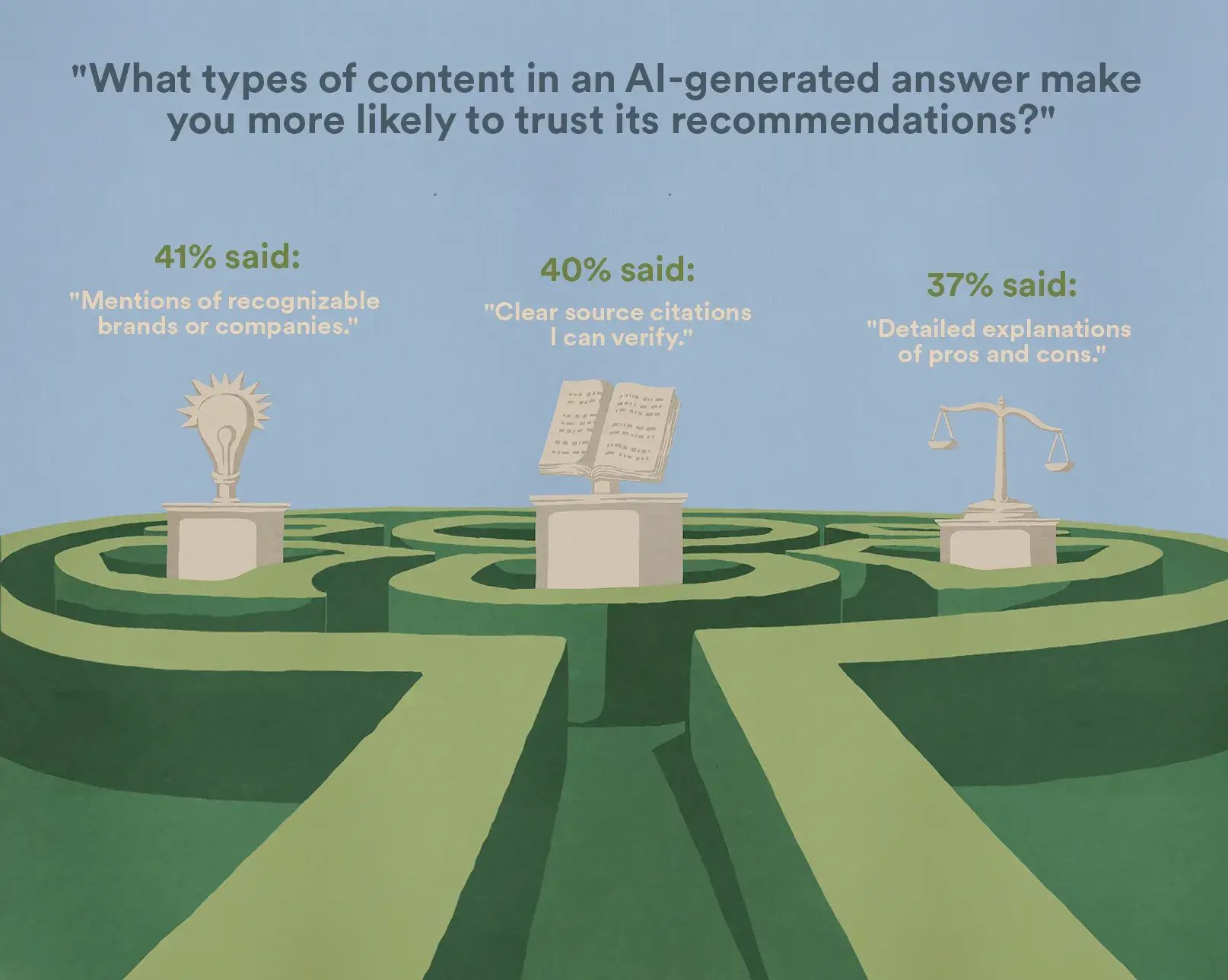
We asked our decision-makers, “What types of content in an AI-generated answer make you more likely to trust its recommendations?”
- 41% said, “Mentions of recognizable brands or companies.”
- 40% said, “Clear source citations I can verify.”
- 37% said, “Detailed explanations of pros and cons.”
We also asked, “When an AI-generated search answer (like Google’s AI Overviews) recommends a product or service, what makes you click through to learn more about that specific brand?”
- 43% said, “The AI answer mentioned a specific feature I need.”
- 43% said, “The brand name was already familiar to me.”
- 29% said, “The source cited looked credible.”
Why buyers trust an AI answer and why they click the links it surfaces don’t necessarily align. Each represents a distinct psychological moment requiring different triggers.
Trust signals hinge on the AI answer itself. Citations, recognized brands, and detailed pros/cons can make buyers take an answer seriously.
Click drivers operate on specific brands within it. Features, pricing, and favorable comparisons might not validate the answer, but they motivate hard engagement.
Consider how our respondents view citations: 41% say verifiable citations build trust, but only 29% say source credibility drives clicks.
Trust stays with the answer. It doesn’t automatically transfer to the recommendation.
A buyer might fully trust an AI answer because it cites credible sources, but they’ll probably click on whichever brand has the feature they need.
Receipt #2: Pricing in AI answers is a major click-driver — even if it’s not a huge trust-builder.
We asked, “When an AI-generated search answer (like Google’s AI Overviews) recommends a product or service, what makes you click through to learn more about that specific brand? (Select all that apply).”
- 43% said, “The AI answer mentioned a specific feature I need.”
- 43% said, “The brand name was already familiar to me.”
- 39% said, “The AI answer included pricing or cost information.”
Cost information is the third-highest AI search click-driver — four points shy of the plurality response. Buyers often click more when AI surfaces pricing, even if it doesn’t automatically build trust.
AI instantly qualifies buyers on price, offering immediate clarity on budget fit.
In the days of yore (five-ish years ago), you’d have to click through to a brand’s website, explore, and potentially request a quote to know if you could afford a product.
AI expedites that process. Buyers who click on a brand already know the number is workable.
It’s a tradeoff. AI can drive action by surfacing prices, but it also controls the context. Buyers might be more inclined to click, but AI frames their initial perception of your offering — not you.
“What does this mean for…”
Social media
Your social content feeds AI’s source material. Posts that establish credibility help AI answers seem trustworthy. Posts that highlight specific capabilities help your brand get clicked within those answers. Both matter, differently.
AI-discovered leads may arrive with pricing expectations already set. If AI framed your cost differently than you would, your email sequence may need to reframe — adding context, explaining value, or clarifying what’s included.
Paid/performance
The 39% who click based on pricing are essentially pre-qualified on budget. Retargeting this segment may show higher conversion rates — they’re not clicking to discover the price, they’re clicking because the price already worked.
Content/brand
Content that gets cited as a source builds trust in AI answers. Content that highlights specific features drives clicks within them. A brand producing only one type may be winning half the battle while losing the other.