
Imelda Burgan has worked for brands as wildly different as Nickelodeon, HubSpot, and MrBeast. But there’s a throughline that applies universally: “Every piece of content should serve a purpose.”
YouTube is no different. But once you’ve got great content, how do you get it in front of the right audience?
Here’s three tips from Burgan you can use to get the absolute most out of your next video.
Meet the Master
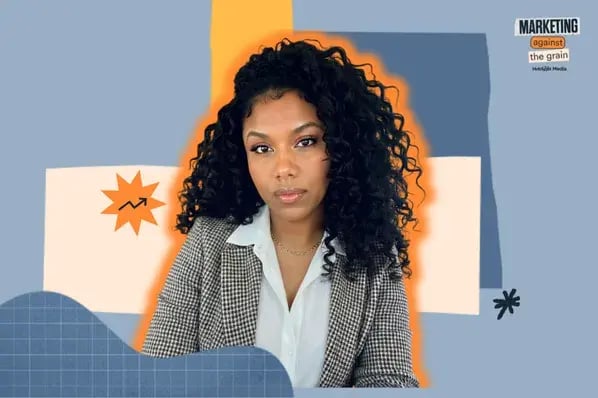

Imelda Burgan
Content strategist, MrBeast
Lesson 1: Shorts are a Costco sample — not a loyalty program.
Imagine: You’re strolling through Costco on a bustling Saturday morning, making a brunch out of chips and dips served in paper ramekins. Somebody offers you some tortilla chips, and they’re pretty delicious!
“You weren’t actually looking for that brand of blue corn chips,” says Burgan, “but hey, they’re offering it up, so I’m gonna give it a nibble.”
But will you buy 5 lbs. of the chips? A taste doesn’t always lead to a purchase.
YouTube shorts aren’t so different. “Shorts aren’t really great at driving people to long-form content,” Burgan tells me. “Just because you have a lot of folks engaging in your shorts doesn‘t mean they’re actually going to watch a 15-minute video.”
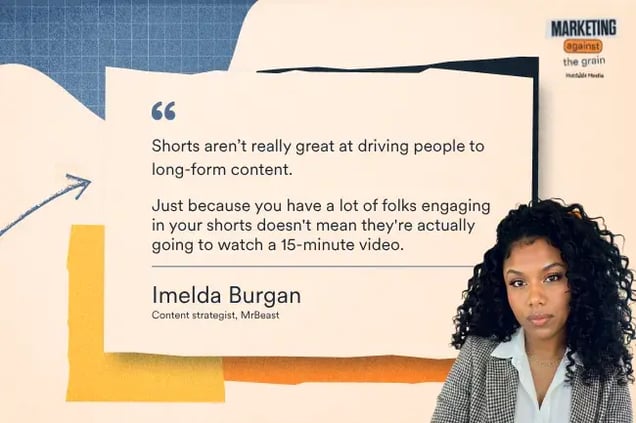
So while YouTube shorts can help get your brand in front of a broad audience, “long-form is really where depth and deep audience engagement is built.”
Lesson 2: Give it a week, then give it a tweak.
Conventional wisdom used to say to wait 30 days before analyzing YouTube analytics. But “the platform has changed so much over time,” Burgan explains, and “by seven days, YouTube has generally pushed your video out there and you have a sense [of its performance]. Is it something that has potential to really grow? Was this a bit of a flop?”
Burgan suggests building a triage plan at the seven-day mark. Maybe structurally, it needs some work, “but can we re-edit in the back end in the studio? Maybe we can cut down the intro.”
Or perhaps retention is strong, “but there‘s a mismatch between what our content is about and what we’ve highlighted on the thumbnail or title. So then some optimization can happen that can really breathe new life into the content.”
Burgan says that changing the metadata in YouTube “actually signals to the algorithm that something has changed. Tweaking the title, tweaking the thumbnail, it can really make a big difference.”
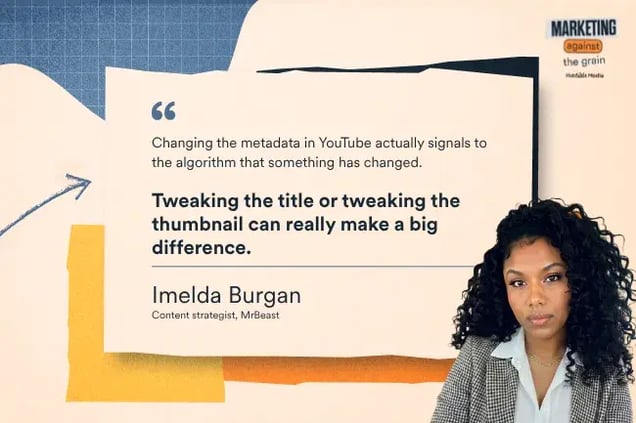
When the algorithm notices these changes, it may prioritize your content and send more traffic your way. This is good news, especially for lower-resource teams — think of it like another lever to pull when you’re publishing content.
Lesson 3: AI can enhance video, but it can’t lead it.
“YouTube is one of those platforms where you really cannot fake authenticity. People feel it out from the very beginning and it doesn't bode well.”
That doesn’t mean that AI is off limits. Burgan says she’s “not a fan” of using AI “solely for leading the script and the storytelling” — but if the heart of the video is human, “you can leverage AI in other ways to enhance it.”
Common applications of AI, Burgan says, include design elements like “in-video graphics, or making the video more entertaining with subtitles and lower thirds [descriptive text along the bottom of a video].” She’s also seeing creators and brands use AI for their backdrops. “You don’t even need a green screen anymore,” she says.
She also points out that using AI for dubbing can help localize your videos and get more bang for your buck. “So, for example, you might have an English channel, but you might have a Spanish-speaking audience that you want to reach. AI for dubbing has really come a long way and it looks pretty natural.”
But there’s a limit, and it can compromise your audience’s trust.
Burgan says that in some videos, “the graphics can be a little over the top [compared to] what the foundation of the video looks like.” This mismatch between video quality and graphics — aside from being visually jarring — can reveal your use of AI to an audience that values authenticity.
Lingering Questions
This Week’s Question
“As audiences become more fragmented and attention spans shorter, what are the most important things marketers should focus on today to actually earn and retain audience attention?” —Essie Acolatse, Associate director, creator success, Spotter
This Week’s Answer
Burgan says: I studied psychology in undergrad, so I think about resonance a lot when it comes to content.
Attention spans are definitely shorter, but I think what actually matters is whether your message resonates.
When you create something that speaks to what your audience is experiencing, whether that‘s frustration, curiosity, or just feeling like someone gets it, people naturally want to keep watching. There’s something about playfulness and whimsy in that, too.
The marketing campaigns doing well aren't necessarily the ones with the slickest production. They're creating content that feels human, that delights people. Resonance taps into something deeper, something that pulls people in without them having to think about it.
It's less about fighting for attention and more about creating something that matters to the person on the other side of the screen.
Next Week’s Lingering Question
Burgan asks: As podcasting evolves, discovery still feels like one of the biggest challenges. But the game has definitely changed with more podcasters using short-form clips, video, and cross-platform repurposing to get found. So I'm curious, what do you think is the most underutilized strategy right now for helping podcasters actually break through, especially in such a saturated space?

![Stop wasting homepage traffic [3 big mistakes backed by 10+ years of data]](https://marketingagainstthegrain.com/hubfs/angela-gomez-matg-blog.webp)


![What We Didn’t Do Boosted Our Paid Ad CVR by 11% [Expert Interview]](https://marketingagainstthegrain.com/hubfs/rebecca-hinton-matg-blog.webp)


