Friday Feature
The issue isn’t audience growth itself. The issue is waiting too long to learn what actually makes your work sustainable.
Creators can spend years building attention, but attention alone doesn’t tell you whether you’re building a business. In Estep’s view, creators should grow their audience while testing value early. “That doesn’t mean over-monetizing. It means figuring out what your audience trusts you for and what can support a real business over time,” he says.
That distinction matters because creators often rely on the wrong signals when they evaluate success. And this isn’t just a creator problem — if you’re doing SMB marketing, how much of your strategy is built around discoverability, and how much is building something you own?
The metric that’s lying to your face
Take follower count.
It’s one of the most visible metrics in the creator economy, and according to Estep, host of the podcast Content Creator's Accountant, one of the least reliable indicators of long-term business health.
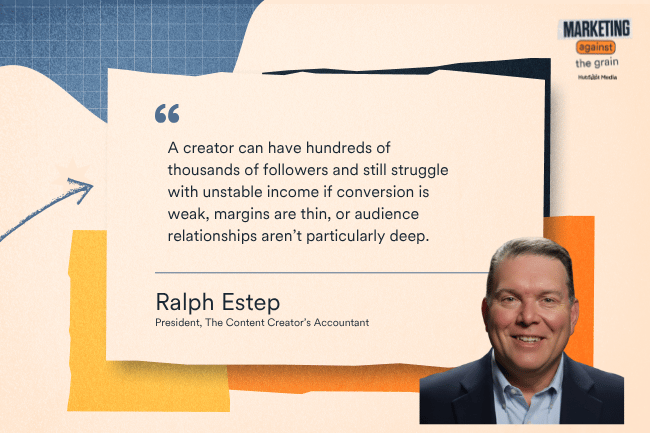
“A creator can have hundreds of thousands of followers and still struggle with unstable income if conversion is weak, margins are thin, or audience relationships aren’t particularly deep. Meanwhile, a smaller audience with strong trust and repeat action is often much more valuable.
If that sounds counterintuitive, it’s because platforms have spent years training creators to think bigger automatically means better.
For a long time, growth strategies centered around discoverability. Find a content format that works, post consistently, and lean into whatever the algorithm rewards.
And to be fair, that approach often worked.
But sometimes the platform changes, competition increases, or the creator wants to evolve. Estep sees a common problem emerge when creators become too dependent on those systems. “They built discoverability, not loyalty,” he told me.
That observation stuck with me because discoverability and loyalty can look very similar while things are going well. Both create growth. Both create views. Both create momentum.
Estep also pointed out another pattern that hides in plain sight: Visibility can create the illusion of financial stability, even when the business itself is actually fragile.
We’ve all seen creators who appear to be everywhere at once. They’re posting constantly, landing partnerships, appearing on podcasts, speaking at events, and staying highly visible online.
From the outside, that can look like a thriving business.
But “behind the scenes, it may depend on high production costs, inconsistent deal flow, thin margins, and a nonstop content treadmill,” he says.
So… what actually lasts?
When I asked Estep what separates creators who last from creators who simply ride a wave, his answer wasn’t content volume or follower count: It was assets.
The creators who endure are often the ones who own more of their “audience relationship, diversify their revenue, understand their margins, and build value that survives platform changes,” he explains.
Follower count doesn’t make the list.
And when you look closely at the creators who have built lasting businesses, a pattern starts to emerge.
MrBeast is probably the clearest example. The channel is enormous, but the more important story is what exists beyond YouTube itself: Feastables, merchandise, and a growing portfolio of brand extensions he owns outright.
“He’s turning audience members into customers, not just views into ad revenue. That creates a longer-term business and diversifies the relationship he has with his audience,” Estep says.
But this isn’t just a recent trend tied to massive YouTube fame.
Pat Flynn represents an even longer arc. He’s been building online since 2008, which is rare longevity in the creator economy. He started with a niche study guide, expanded into Smart Passive Income, then layered in podcasts, courses, software, and community products over time. What makes the model durable is that no single revenue stream carries the business.
Attention is the door. Ownership is the house.
A newer generation of creators is following a similar blueprint.
Codie Sanchez is a more recent example, but one worth paying attention to. Contrarian Thinking operates like a modern media company: The newsletter drives attention, while paid communities, courses, and business education sit underneath it. The content is the door; she owns the house.
What Estep noticed is that all of these creators use platform momentum to build something they actually own.
The ones who rode a wave will be the ones whose success was tied too closely to a specific algorithm, format, or moment in the market.
That may ultimately be the dividing line between creators who build enduring businesses and creators who simply ride a wave.